




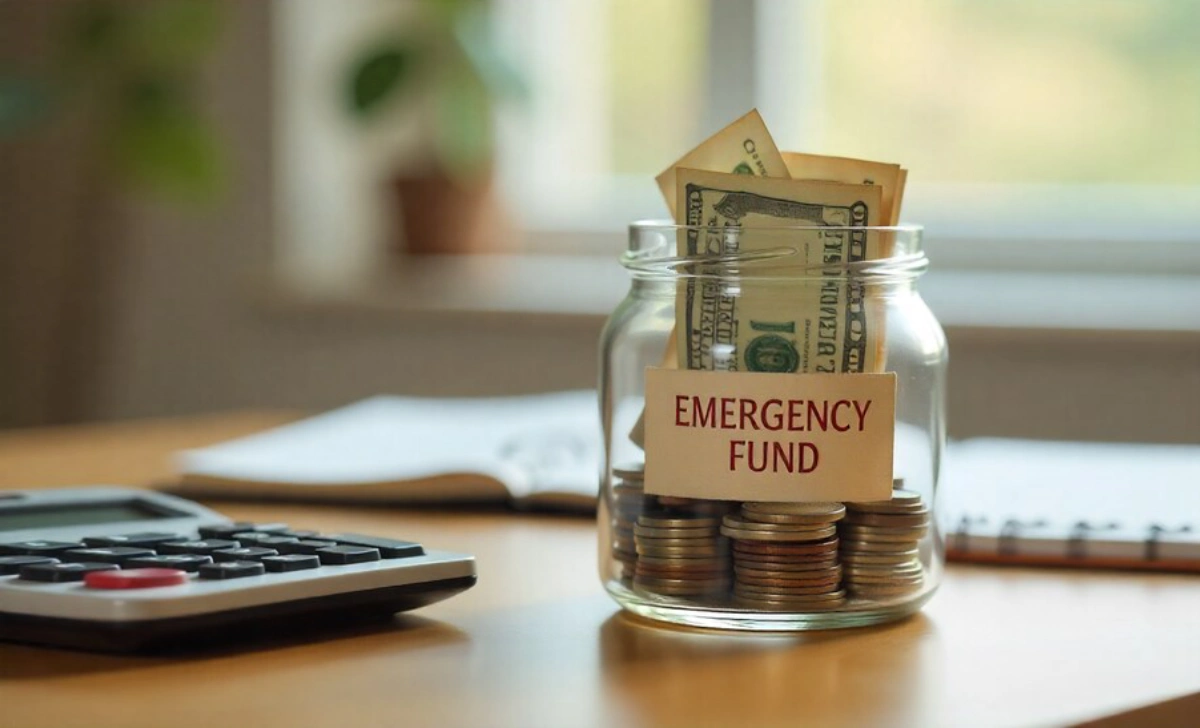
Emergency fund planning protects you from financial disaster when unexpected expenses strike. Without a proper emergency fund, you risk accumulating high-interest debt, missing bill payments, or depleting retirement accounts during a crisis. A well-structured emergency fund—covering three to six months of essential expenses—acts as your financial safety net for job loss, medical emergencies, car repairs, or home maintenance issues.
Starting your emergency fund requires three steps: calculate your monthly essential expenses, choose a high-yield savings account separate from your checking, and automate regular contributions. Even saving $25 per week builds $1,300 annually. The key is starting now, regardless of your current financial situation, and treating your emergency fund as a non-negotiable monthly expense.
Introduction
Last month, Maria’s car broke down on her way to work. The repair bill? $1,200. She had $300 in savings. The choice she faced happens to millions of Americans every year: charge it to a credit card at 24% interest, skip the repair and lose her job, or borrow from family.
A Federal Reserve study from 2024 found that 37% of Americans couldn’t cover a $400 emergency expense using cash or savings. That single statistic explains why so many people spiral into debt despite working full-time jobs. Your income doesn’t protect you from financial catastrophe—your emergency fund planning does.
This guide shows you exactly how to build your financial safety net from scratch. You’ll learn how much to save, where to keep your money, and realistic strategies for funding your emergency account—even if you’re living paycheck to paycheck right now. By the end, you’ll have a concrete action plan to start protecting yourself today.
Why Emergency Fund Planning Changes Everything
Think of emergency fund planning as buying insurance you already own. You pay premiums on car insurance, health insurance, and homeowners insurance. Your emergency fund ensures you against life’s financial curveballs—and you get to keep the money.
Without emergency fund planning, a single unexpected expense creates a domino effect. You charge the car repair to a credit card. The minimum payment strains next month’s budget. You pay another bill late. Late fees pile up. Your credit score drops. Now you’re paying higher interest rates on everything, and the cycle deepens.
The average American faces roughly three to four financial emergencies per year, according to banking industry research. These include medical bills, car repairs, home maintenance, emergency travel, or temporary income loss. Each emergency costs anywhere from $500 to $5,000. Add them up, and you’re looking at $2,000 to $20,000 in unexpected expenses annually.
People with emergency funds report significantly lower stress levels and better physical health. A 2024 study by the American Psychological Association found that financial stress contributes to 72% of Americans’ anxiety. When you know you can handle a $2,000 emergency without borrowing, your entire relationship with money shifts. You make better decisions. You sleep better. You stop living in constant fear of the next financial disaster.
How Much You Actually Need
Financial experts recommend saving three to six months of essential expenses. That range exists because your target depends on your specific situation.
Save three months of expenses if you have:
- Dual-income household
- Stable job with a strong employer
- Good health insurance
- No dependents
- Reliable vehicle paid off
Save six months or more if you have:
- Single-income household
- Self-employed or freelance income
- Health concerns or high medical costs
- Dependents (children, elderly parents)
- Specialized career with a limited job market
Calculate your target by listing monthly essentials: rent or mortgage, utilities, groceries, insurance premiums, minimum debt payments, transportation, and basic healthcare. Skip the entertainment subscriptions, dining out, and discretionary spending. You’re calculating survival mode expenses, not your normal lifestyle.
Jake, a 28-year-old graphic designer, calculated his essential monthly expenses at $2,400. His comfortable lifestyle costs $3,800 monthly, but he could survive on $2,400 if he eliminated restaurants, entertainment, and unnecessary purchases. As a freelancer with variable income, he aimed for six months: $14,400. That number felt overwhelming at first, but he broke it into manageable milestones: $1,000, then $2,500, then $5,000, and so on.
Where to Keep Your Emergency Fund
Your emergency fund needs three qualities: safety, liquidity, and separation from daily spending.
High-yield savings accounts offer the best combination. As of 2025, online banks offer 4% to 5% annual percentage yields—dramatically better than traditional banks paying 0.01%. Your money grows while remaining completely accessible. You can typically transfer funds to your checking account within one business day.
Money market accounts work similarly to high-yield savings but may require higher minimum balances. They sometimes include check-writing privileges, making them slightly more accessible.
Keep your emergency fund separate from your checking account. The physical separation creates a mental barrier against casual spending. You want accessing this money to require an intentional transfer, not an impulse swipe of your debit card.
Avoid these options:
- Checking accounts (too tempting to spend)
- Stocks or mutual funds (too volatile for emergencies)
- Retirement accounts (penalties and taxes destroy the value)
- Under your mattress (no growth, theft risk)
Getting Started When Money Is Tight
The biggest mistake people make? Waiting until they can afford to save. You can’t afford not to save. The next emergency doesn’t care about your current financial situation.
Start with $25 per week. That’s one fewer takeout meal, two fewer coffee shop visits, or one streaming service cancellation. In one year, you’ll have $1,300. In two years, $2,600. That’s enough to handle most common emergencies without touching a credit card.
The Starter Emergency Fund Strategy
Begin with a mini-goal: $500 to $1,000. This covers most small emergencies and breaks the paycheck-to-paycheck cycle. Once you hit this milestone, you’ll feel the psychological shift that comes from having a cushion.
Automate your savings the day after payday. Set up an automatic transfer from checking to your emergency fund savings account. When the money moves before you see it, you adapt your spending to what remains. Waiting until the end of the month to save whatever’s left over never works—there’s never anything left over.
Find the money by conducting a 30-day spending audit. Track every dollar for one month using a notebook, spreadsheet, or budgeting app. You’ll discover $100 to $300 monthly in spending you didn’t realize was happening. Redirect that money to your emergency fund.
The Accelerated Funding Method
Once you’ve established the habit, accelerate your progress with these strategies:
Windfall captures: Direct 100% of unexpected money to your emergency fund. Tax refunds, work bonuses, birthday cash, garage sale proceeds, or side gig earnings all go straight to savings. Windfalls can add $1,000 to $5,000 annually to your emergency fund.
The side hustle surge: Add $500 to $1,500 monthly by monetizing skills you already have. Freelance writing, graphic design, tutoring, pet sitting, driving for rideshare services, or selling handmade items online all generate emergency fund money. Commit to funding your emergency savings exclusively from side income for 6 to 12 months.
The debt payoff pivot: After paying off a debt, redirect that payment amount to your emergency fund instead of absorbing it into your lifestyle. Finished paying off a $200 monthly car loan? That $200 now funds your emergency savings automatically.
The challenge approach: Try a 30-day no-spend challenge on a specific category. Don’t eat out for 30 days. Don’t buy clothes for 30 days. Don’t spend on entertainment for 30 days. Deposit your typical spending in that category directly to your emergency fund.
Rachel, a 35-year-old nurse with two kids, combined these methods. She automated $100 per paycheck, captured her $2,400 tax refund, and started a weekend pet-sitting service earning $400 monthly. In 14 months, she built a $12,000 emergency fund—six months of essential expenses. She told me that financial security changed everything about how she approached daily decisions.
Common Mistakes That Sabotage Your Progress
Mistake 1: Keeping your emergency fund too accessible
Linking your emergency fund to your checking account or keeping a debit card for it invites casual spending. “I’ll just borrow from my emergency fund and pay it back” turns into permanent depletion. Open your emergency fund at a different bank entirely.
Mistake 2: Using your emergency fund for predictable expenses
Christmas gifts, annual insurance premiums, and car registration aren’t emergencies—they’re irregular but predictable expenses. Create a separate sinking fund for these known costs. Reserve your emergency fund for true surprises.
Mistake 3: Stopping contributions after reaching your goal
Life changes. Rent increases. Family size grows. Income fluctuates. Review your emergency fund target annually and adjust for life changes. What covered six months of expenses two years ago might only cover four months now.
Mistake 4: Investing your emergency fund for higher returns
The stock market can drop 30% to 50% during economic crises—exactly when you’re most likely to need emergency money. Your emergency fund’s job isn’t growth; it’s protection and availability. Accept the lower returns in exchange for guaranteed access.
Mistake 5: Never using it when real emergencies strike
Some people save diligently but feel too guilty to use their emergency fund during actual emergencies. That’s like buying fire insurance and refusing to file a claim when your house burns down. If you face job loss, major car repairs, or medical bills, use the fund. That’s why you built it. Then prioritize rebuilding it afterward.
Your 7-Day Emergency Fund Kickstart Plan
Day 1: Calculate your monthly essential expenses. Write down every non-negotiable cost: housing, utilities, food, transportation, insurance, minimum debt payments, and basic healthcare.
Day 2: Set your initial target. Multiply your essential monthly expenses by three for a starter goal. This becomes your finish line.
Day 3: Research and open a high-yield savings account at an online bank. Compare rates at multiple institutions. Look for no minimum balance requirements and no monthly fees.
Day 4: Fund your new account with your starting amount—even if that’s only $25.
Day 5: Set up automatic transfers. Schedule weekly or biweekly transfers from your checking account to your emergency fund. Start with an amount that feels uncomfortable but possible.
Day 6: Identify your first $500. Review last month’s spending and find expenses you can eliminate or reduce. Calculate how quickly you can reach your first milestone of $500 to $1,000.
Day 7: Create accountability. Tell a trusted friend or family member about your goal. Share your target date for reaching $1,000. Consider finding an accountability partner who’s also building an emergency fund.
Maintaining Your Emergency Fund Long-Term
Building the fund is half the battle. Maintaining it requires discipline and clear boundaries.
Define what qualifies as an emergency before you face one. True emergencies threaten your health, safety, housing, employment, or basic needs. A sale on electronics doesn’t qualify. Concert tickets aren’t emergencies. Wanting to upgrade your phone isn’t an emergency.
Create a replacement plan for when you use emergency funds. If you tap $1,500 for car repairs, immediately create a plan to replenish that $1,500 within three to six months. Temporarily increase your automatic transfers or find additional income until you’ve restored the fund to its target level.
Celebrate milestones without sabotaging progress. Reaching $1,000, $5,000, or your full target deserves recognition. Treat yourself to a small, planned reward—a nice dinner out or a small purchase you’ve wanted—but keep it proportional. Don’t celebrate saving $5,000 by spending $500.
Frequently Asked Questions
Should I build an emergency fund or pay off high-interest debt first?
Do both, but prioritize differently. Build a starter emergency fund of $500 to $1,000 first. This prevents new debt during your debt payoff journey. Then attack high-interest debt aggressively while maintaining minimum emergency fund contributions. After eliminating high-interest debt, redirect those payments to complete your full emergency fund.
What if I’m self-employed with irregular income?
You need a larger emergency fund—aim for 9 to 12 months of expenses. Self-employed income fluctuates, and you lack unemployment benefits. During high-income months, save aggressively. During low-income months, your emergency fund smooths the gaps. Consider this fund part of your business infrastructure, not optional.
Can I use my emergency fund as a down payment for a house?
No. That’s your emergency fund’s job—handling emergencies. Save separately for your down payment. If you drain your emergency fund for a down payment, you’ll be a homeowner without financial protection. Home ownership creates new emergency expenses: broken HVAC systems, roof leaks, appliance failures. You need your emergency fund more as a homeowner, not less