





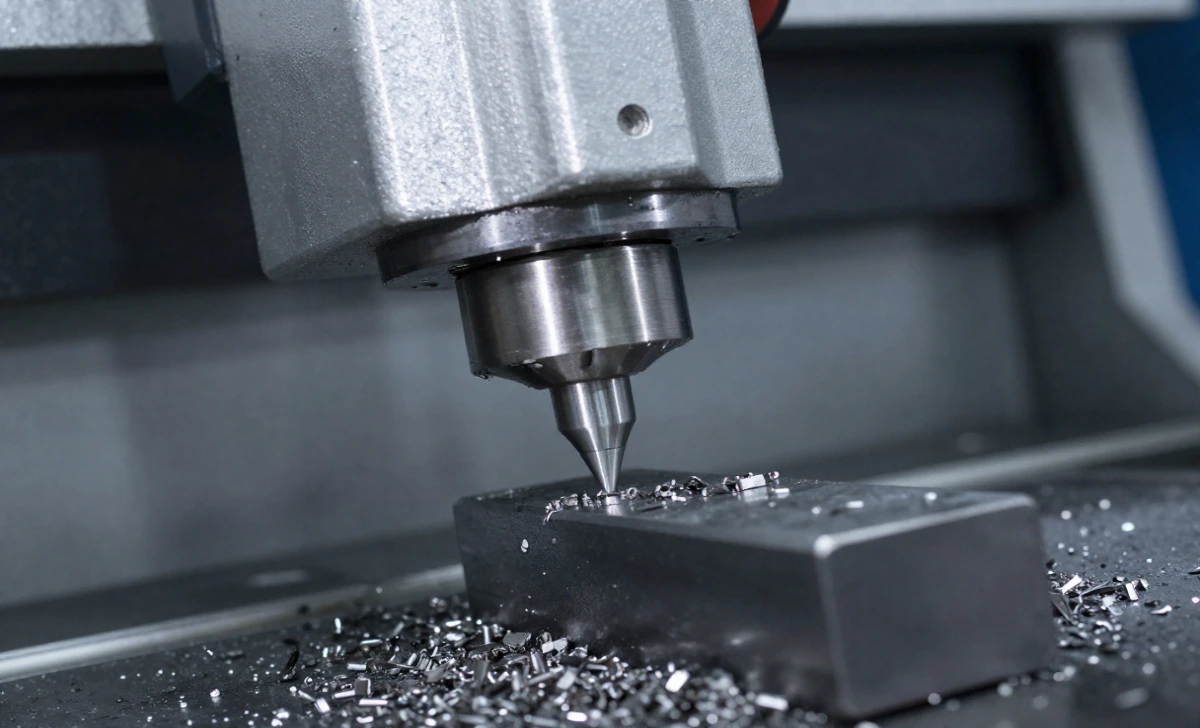
A Winkelbohrspindel is a machining attachment that redirects your main spindle’s rotation, usually 90 degrees, so you can drill, mill, or tap at angles without moving the workpiece. It mounts to your CNC machine like any other tool and uses internal bevel gears to transfer power in a new direction.
For shops dealing with complex parts or tight-access features, a right-angle spindle can cut setup time significantly, reduce the risk of alignment errors, and make single-clamping possible on jobs that once needed three or four repositions. The value is not in the complexity of the tool itself, but in what it saves you downstream.
What a Winkelbohrspindel Actually Is
If you work in a machine shop long enough, you will eventually hit a job where the standard spindle just cannot get there. The hole is on the side of a casting. The feature sits in a cavity. The part is too large to rotate without a complex fixture. That is where a Winkelbohrspindel comes in.
The name is German: “Winkel” means angle, “Bohr” means drill, and “Spindel” means spindle. Together, it describes an angular drilling spindle, sometimes called an angle head or right-angle spindle. The tool mounts to your machine’s spindle nose or tool holder, receives rotation from the main spindle, and redirects it at an angle through internal gearing.
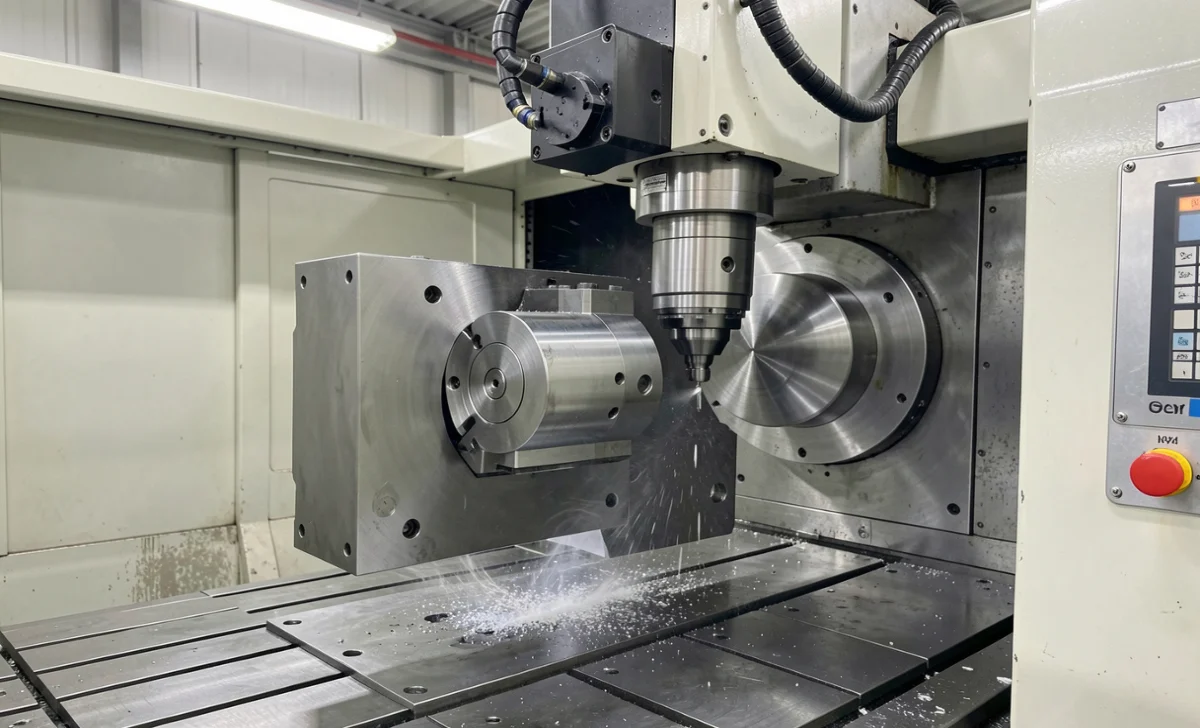
Unlike a standard spindle, which drives the tool straight down the machine’s Z-axis, a Winkelbohrspindel drives the tool sideways or at a preset angle. That single difference changes what your machine can do without touching the part.
Fixed vs. Adjustable: Which Type Do You Need
Not all angle heads work the same way, and picking the wrong type is an easy mistake when you are buying your first one.
Fixed-angle models lock at a set angle, most commonly 90 degrees. They are more rigid, easier to program, and better suited for repetitive work where you always need to hit the same angle. Most shops start here, and many never need anything else.
Adjustable-angle models let you set the output angle across a range, which is useful when part geometry changes job to job. The trade-off is that they add complexity, cost more, and require careful locking before each use. A loose adjustment on an adjustable-angle head will ruin your surface finish and potentially your part. You can read more about precision CNC attachments here if you want to understand how adjustable tooling fits into broader machining strategies.
For most shops, a solid fixed 90-degree model handles the large majority of jobs. Buy adjustable only if your work genuinely requires it.
How It Improves Efficiency in Real Shops
The clearest benefit of a Winkelbohrspindel is fewer setups. When you can machine the top and sides of a part in one clamping, you eliminate realignment steps, reduce operator time, and lower the risk of cumulative positioning errors.
In practice, a job that once needed three separate setups with a tilt table and two clampings can become a single-clamping operation. That saves machine time, labor time, and reduces the chance of a part ending up out of tolerance because it shifted between setups.
In my experience, shops doing aerospace brackets, engine housings, or mold cavities see the biggest gains. Side features, cross-holes, and angled tapped holes are common in that type of work, and a precision drilling tool designed for exactly those situations pays for itself quickly. The production efficiency discussion here gives useful context on how tooling choices affect output across a shift.
The key is that the workpiece does not move. Every time you reclamp, you introduce a variable. Fewer clampings means fewer variables.
What to Consider When Choosing One
Buying a Winkelbohrspindel without matching it to your machine and your work is a fast way to be disappointed. Here is what actually matters.
Your machine’s spindle interface comes first. Check whether you need HSK, CAT, BT, or another taper. The connection between your machine and the angle head affects rigidity directly. A poor fit creates movement, and movement creates tolerance problems.
Speed and torque ratings come next. Your angle head needs to handle the RPM your spindle delivers. Many fixed-ratio models pass speed through at 1:1, but torque loading changes through the gearing. Check manufacturer specs against your typical cutting conditions, especially in steel.
Coolant delivery is worth checking too, particularly for deeper holes. Through-tool coolant helps with chip evacuation and tool life. Not every angle head supports it, and not every machine delivers it, so confirm both sides of that equation before you buy. You can find a useful breakdown of CNC machining attachment considerations here that covers interface and coolant compatibility in more detail.
Finally, consider sealed versus serviceable lubrication systems. Some angle heads are lifetime-sealed and low-maintenance. Others require periodic greasing. Both work, but know what you are committing to before you decide.
Installation, Setup, and Safety
Set up is where a lot of shops lose the value they paid for. Taking shortcuts here leads to chatter, poor finishes, and sometimes crashes.
Start by cleaning the spindle taper and the angle head’s shank thoroughly. Even small chips or surface contamination change how the tool seats, which affects runout. Once mounted, indicate the head in and check runout before cutting. It takes about fifteen minutes and is worth every second.
Program tool length offsets carefully. Your CAM system needs an accurate model of the angle head assembly to calculate correct tool paths. If the model is off, your paths will be off. Check the first part before running a full batch.
From a safety standpoint, angle heads add overhang and side loads that your standard tool paths do not account for by default. Start with lighter cuts than you think you need. Peck drilling instead of continuous feed in deeper holes reduces the risk of deflection and tool breakage. Watch for vibration, especially at higher RPMs, and back off immediately if it appears. Overheating is also a real risk if you push speeds without adequate coolant. Let the head cool between heavy operations if you are running it hard.
The Cost and ROI Reality
A quality Winkelbohrspindel typically runs from a few thousand dollars into the tens of thousands for specialized or multi-output versions. That number stops some shops before they calculate what it actually costs them to not have one.
Look at your last month of work. How many angled features did you machine? How many extra setups did those features require? Multiply those setups by your machine’s hourly rate and your operator’s time. In many shops, that math justifies the purchase in weeks, not months.
The shops that do not benefit are those with genuinely rare angled work. If you see one or two such jobs a year, subcontracting that work or using a tilt table makes more sense. But if angled features show up consistently, the ROI on a solid CNC machining attachment is usually straightforward.
When a Different Tool Makes More Sense
A Winkelbohrspindel is not the right answer for every situation. It is worth knowing when something else works better.
Five-axis CNC machines handle complex multi-angle work more fluidly than any attachment can. If your shop regularly runs parts that require simultaneous multi-axis motion, rather than indexed angular drilling, a five-axis machine is the better long-term investment. Angle heads work well for indexed, fixed-angle features. They are not a replacement for true multi-axis capability.
Tilt tables and sine plates are cheaper and more rigid, and they work well for simple angled setups when precision requirements are moderate. If you only need a 30-degree feature on a soft-material part once a week, a tilt table gets the job done without the cost of an angle head.
Downsides Worth Knowing Before You Buy
No tool is perfect, and this one has real trade-offs.
Angle heads add length to your tool assembly, which costs you Z-travel and can create clearance issues in tight work envelopes. Check that the spindle, head, and tool combination fits your machine before committing to a setup. They also require accurate CAM models, so if your programming setup is not dialed in, you will spend time troubleshooting paths instead of cutting parts.
Maintenance matters more than most people expect. Neglected angle heads develop backlash in the gears and runout in the bearings. That shows up in your parts before you realize the tool is the problem. Regular runout checks and proper cleaning after use keep the head performing the way it should.
FAQs
What is a Winkelbohrspindel, and how does it differ from a standard spindle?
A Winkelbohrspindel is an angular drilling spindle that mounts to your machine’s main spindle and redirects the cutting tool at an angle, usually 90 degrees. A standard spindle drives tools straight along the Z-axis. The angle head adds lateral machining capability without moving the part.
How can a Winkelbohrspindel improve efficiency in my workshop?
It reduces the number of setups needed to machine angled features. Fewer setups mean less realignment time, lower risk of positioning errors, and faster cycle times overall.
What factors should I consider when choosing a Winkelbohrspindel for my CNC machine?
Match the spindle interface to your machine, confirm the speed and torque ratings fit your cutting conditions, check coolant delivery compatibility, and decide between fixed and adjustable-angle models based on your typical work.
Are there any downsides to using a Winkelbohrspindel in everyday machining?
Yes. They add overhang and reduce Z-travel. They require accurate CAM programming, careful setup, and regular maintenance. They also involve upfront cost that only make sense if you machine angled features regularly.
Disclaimer: This article is written for general informational purposes. Machine specifications, safety practices, and tooling recommendations vary by manufacturer and application. Always consult your machine’s documentation and the angle head manufacturer’s guidelines before installation and use.