





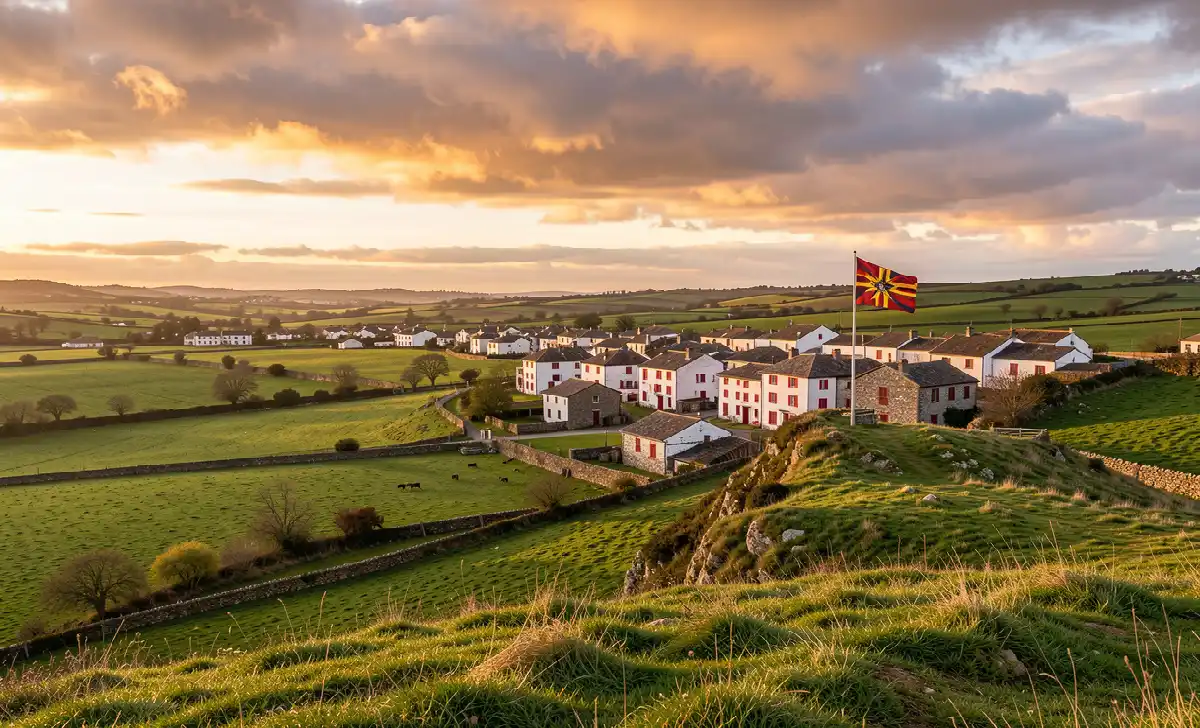
Basque separatists are political movements seeking self-governance or full independence for the Basque people — a distinct ethnic group with their own ancient language, living across northern Spain and southwestern France. The movement was once defined by ETA, a violent group that dissolved in 2018. Today, it operates entirely through democratic politics, with fewer than 25% of Basques supporting full independence.
Basque separatists are political movements — and until recently, an armed organization — seeking self-rule or full independence for the Basque people. The Basques are a distinct ethnic group with their own ancient language, living across northern Spain and southwestern France. For decades, their independence movement was defined by ETA, a violent group that killed more than 800 people before dissolving in 2018. Today, the movement is entirely political — and more divided internally than it appears from the outside.
Support for full independence sits below 25%, according to surveys by Euskobarometro, the University of the Basque Country’s polling institute. Yet Basque nationalist parties made major gains in the 2024 elections. The real question isn’t whether the Basques will take up arms again — they won’t. It’s whether a prosperous, highly autonomous region with its own taxes, police force, and school system still has a compelling reason to pursue full independence at all.
Who Are the Basques?
The Basque separatism story starts with the people themselves, not with any political party.
The Basques live in a region they call Euskal Herria — seven provinces straddling northern Spain and southwestern France. Anthropologists consider them one of Western Europe’s oldest indigenous populations. Their exact origins remain debated, but their distinctiveness from their neighbours is not.
Their language, Euskara, makes that distinction clearest. Linguists classify it as a language isolate — meaning it shares no common ancestry with Spanish, French, or any other living language on Earth. When Franco’s dictatorship banned it from public life after 1939, the wound wasn’t just cultural. For Basques, suppressing Euskara meant suppressing the core of their identity.
Today, Euskara is making a genuine comeback. Immersion schools called ikastolas have produced generations of fluent young speakers. You hear it in cafes, on social media, and in regional government chambers. That linguistic revival runs alongside the political one — and helps explain why Basque nationalism still resonates even as support for full independence has softened.
The Roots of Basque Separatism
Basque nationalism as a formal movement began in the late 19th century with Sabino Arana, who founded the Basque Nationalist Party (PNV) in 1895. He framed Basque identity in ethnic and religious terms, arguing that industrialization and migration from other parts of Spain were erasing a distinct way of life.
For centuries before that, Basque territories operated under the Fueros — traditional laws that granted them real self-governance within Spain. When Madrid abolished those rights in 1876, following the Third Carlist War, it created a resentment that never fully healed.
When Franco came to power after the Spanish Civil War, that resentment hardened. Franco-allied forces — including Nazi Germany’s Condor Legion — bombed the Basque town of Guernica in 1937, an act of deliberate cultural and military terror. Franco then banned Euskara, suppressed Basque institutions, and tried to erase Basque culture from public life entirely.
Out of that suffocation, ETA was born.
ETA: The Violence That Defined a Generation
ETA — Euskadi Ta Askatasuna, meaning “Basque Homeland and Freedom” — formed in 1959, initially as a student resistance movement frustrated with the PNV’s non-violent approach. Under Franco’s repression, the group shifted to armed struggle, carrying out bombings, assassinations, and kidnappings across Spain.
By the time ETA completed its disarmament in 2017 and formally dissolved in 2018, it had killed more than 800 people — police officers, politicians, military officials, and civilians. The group saw themselves as freedom fighters. The Spanish government — and eventually most of Spain — saw them as terrorists.
The trajectory matters here. During the Franco years, ETA had genuine social support in some Basque communities. People who watched their culture get crushed sometimes saw ETA as the only group willing to push back. But once Spain returned to democracy in the late 1970s and the Basque Country gained substantial autonomy through the Gernika Statute of 1979, that support eroded fast.
What the Gernika Statute actually granted is worth spelling out. It gave the Basque Autonomous Community its own parliament, police force (the Ertzaintza), control over education and health, and — critically — the right to collect its own taxes and negotiate fiscal transfers to Madrid directly, a carryover from the old Fueros tradition. No other Spanish region has that last power. It fundamentally changed the calculus of what independence would actually add.
ETA’s violence outlived its context. By the 2000s, mass demonstrations in Bilbao and San Sebastián drew hundreds of thousands of people demanding that the group stop. The ceasefire came in 2011, witnessed at the Aiete Conference in San Sebastián by a group of international figures including former UN Secretary-General Kofi Annan. Disarmament followed in 2017. Formal dissolution came in 2018.
ETA’s legacy remains painful. Victims’ organizations — including Covite and the Association of Victims of Terrorism (AVT) — continue pushing for fuller acknowledgement of what survivors suffered. Many victims’ cases remain unresolved in terms of official recognition and compensation. Debates over memorials and historical memory still shape Basque politics, and they shape how Madrid approaches any conversation about expanded autonomy.

From Armed Conflict to the Ballot Box
The end of ETA’s violence did not end Basque nationalism. It redirected it into democratic politics — and the 2024 elections showed how much energy that channel still carries.
In the April 2024 Basque regional elections, the left-wing coalition EH Bildu won 22 seats in the regional parliament, coming close behind the moderate PNV’s 27. It was EH Bildu’s strongest result yet — drawing younger, more progressive voters who want self-determination without any association with ETA’s past. EH Bildu’s most prominent figure, Arnaldo Otegi, has worked deliberately to distance the coalition from the armed era.
The two parties represent genuinely different visions:
- PNV — the dominant force for most of the past century- takes a gradualist approach. It extracts more powers from Madrid incrementally through negotiation, treating autonomy as an evolving relationship rather than a destination.
- EH Bildu — wants a legal referendum on independence and frames self-determination as a democratic right, not a threat. It has moved away from ETA’s legacy but still pushes further than the PNV is willing to go.
The Basque Autonomous Community already holds more real power than almost any other region in Europe:
- Its own police force (the Ertzaintza)
- Full control over education and health systems
- The right to collect its own taxes and negotiate fiscal transfers to Madrid directly
That fiscal autonomy is not a small thing. It gives the Basque Country genuine economic independence from Madrid that regions like Catalonia don’t have. It also complicates the case for full separation — when you already control your own money, what does independence actually add?
Current Euskobarometro surveys show support for full independence below 25%. A large share of Basques are satisfied with their existing autonomy or want further devolution without a clean break. The independence movement’s challenge now is less about fighting Madrid and more about persuading its own neighbours.
The Constitutional Barrier — Why a Legal Referendum Is Blocked
This is the part most explainers skip, and it matters.
Spain’s Constitution — specifically Article 2 — declares the country “indivisible” and grants the central government authority over questions of national unity. Unlike the United Kingdom, which allowed Scotland’s 2014 independence referendum through a negotiated Section 30 order, Spain has no equivalent legal mechanism for authorizing a regional independence vote.
Catalonia tested this in 2017 by holding an unauthorized referendum. Madrid declared it illegal, suspended Catalonia’s autonomy temporarily, and prosecuted the organizers. Basque nationalist parties have specifically avoided that path — they want a negotiated, constitutional route.
The problem is that no such route currently exists in Spanish law. Any change would require either a constitutional amendment (which needs broad parliamentary support that doesn’t exist) or a political agreement that Madrid has not been willing to make.
Where Basque parties do have leverage is in national politics. The current Spanish government under Pedro Sánchez relies on Basque nationalist votes in parliament to maintain its majority. That dependence gives Basque parties real influence over national policy — on budget negotiations, legislation, and appointments — without needing independence to exercise it. For the PNV in particular, this is arguably a more effective strategy than pushing for a referendum they can’t legally hold.
The French Basque Country: The Overlooked Half
Most coverage of Basque separatism focuses entirely on Spain. That misses half the story.
The French Basque Country — called Iparralde in Euskara — covers three provinces in southwestern France: Labourd, Soule, and Lower Navarre. Together with Spain’s four Basque provinces and the contested territory of Navarre, they form the seven-territory Euskal Herria that Basque nationalists consider their homeland.
Navarre is worth flagging specifically. It’s a Spanish autonomous community with its own statute, and it has a complicated relationship with Basque identity — some of its population identify as Basque, others don’t, and its political parties span the spectrum from Spanish nationalist to pro-Basque. Any discussion of what a Basque state would actually look like runs straight into the Navarre question, which no one has a clean answer to.
The French side has historically been less politicized. Paris does not grant the same level of regional autonomy that Madrid does, and France’s approach to regional identity has traditionally been more centralized. But that is shifting.
In 2024, a pro-autonomy candidate won a seat in France’s National Assembly representing the French Basque Country. Cross-border coordination between Spanish and French Basque movements is growing: shared Euskara education programmes, joint cultural events, and increasing political contact between elected officials on both sides of the Pyrenees.
For activists and long-term planners, the French dimension shapes the vision of what an eventual Basque entity could look like — and why the movement frames itself as a cross-border cultural project, not simply a dispute with Madrid.
Basque vs. Catalan: What’s Actually Different
Anyone following Spanish politics will notice the obvious comparison. Both are wealthy regions. Both have distinct languages and identities. Both have strong independence movements. But the two cases are meaningfully different.
- Legality of a referendum: Catalonia’s 2017 independence referendum was held without Madrid’s consent and declared illegal. The Basque movement has not attempted the same — it seeks a negotiated, constitutional pathway, which doesn’t currently exist but is at least theoretically possible.
- Violence: ETA’s history means the Basque movement carries a legacy the Catalan movement does not. That shapes how Madrid negotiates — and how the rest of Spain perceives Basque demands.
- Fiscal autonomy: The Basque Country already collects its own taxes. Catalonia does not — and fiscal grievances are a primary driver of Catalan independence sentiment. The Basque arrangement removes that specific pressure, which is one reason support for full independence is lower.
- Independence support: Support for independence in Catalonia peaked around 48% in the mid-2010s, according to surveys by the Centre d’Estudis d’Opinió (CEO). In the Basque Country, it sits below 25%.
The Basque model is often cited by analysts as a possible template for resolving the Catalan question — not because the situations are identical, but because the fiscal autonomy arrangement has demonstrably reduced separatist pressure over time.
Could the Basque Country Function as an Independent State?
The economic case is stronger than most people assume. The weaker case is political.
The Basque Country is one of Spain’s wealthiest regions, with GDP per capita among the highest in the Iberian Peninsula. The economy runs on manufacturing, engineering, machine tools, and a strong services sector. Unemployment is consistently below the Spanish national average.
The Mondragon Corporation — headquartered in the Basque town of Arrasate — is one of the world’s largest worker-owned cooperatives, employing around 80,000 people across more than 100 companies. It represents something more than a single employer: it’s evidence that the Basque Country has built sophisticated, long-term economic institutions that operate independently of Madrid.
The case for viability:
- Strong industrial base and export economy
- Existing tax collection infrastructure — unlike most regions, it already operates its own fiscal system.
- Established regional institutions: parliament, police force, courts, and schools
- Historical precedent: Slovenia achieved independence in 1991 with a smaller population and weaker industrial base, and is now a stable EU member
The real risks:
- EU membership gap: An independent Basque Country would not automatically retain EU membership. It would need to apply as a new state, a process that takes years and requires unanimous approval from all existing members — including Spain, which would have strong incentives to delay or block it. This is the single most significant economic risk.
- Fiscal separation complexity: The Basque tax system operates within a framework of obligations to the Spanish state. Disentangling those obligations would require years of negotiation over what the Basque Country owes, what assets it inherits, and how pension and welfare systems transfer.
- Market access: Spain remains the Basque Country’s largest trading partner. Independence wouldn’t end that trade, but it would introduce regulatory friction — customs, standards, labour rules — at a minimum.
The bottom line: the Basque Country has the economic capacity to function as a state. Whether the political will exists to attempt it — and whether Spain would ever agree to a legal referendum — is a different question. Currently, the answer to both is no.
What the Next Three Years Will Actually Determine
The Basque independence movement in 2026 looks nothing like it did in 1980 or even 2010. The guns are gone. The debate has moved to parliaments, school enrollment figures, and election results.
Three things will shape the trajectory:
1. Whether EH Bildu can overtake PNV. If the left-wing coalition becomes the dominant Basque party, the pressure for a formal referendum increases. That doesn’t mean a referendum happens — but it changes the negotiating position with Madrid.
2. How long Sánchez’s government survives. Basque nationalist parties hold leverage precisely because the current Spanish government needs their votes. If that coalition breaks or changes, the leverage shifts. A right-wing Spanish government would be far less willing to negotiate expanded autonomy or anything resembling a referendum framework.
3. How the EU handles the broader question of regional self-determination. Scotland’s case, Catalonia’s case, and the Basque case are all watching each other. If the EU develops a clearer framework for how secessionist regions might retain or fast-track EU membership, it changes the calculus significantly for all of them.
The Basques have been making this argument, in one form or another, for over 150 years. The tools keep changing. The underlying question — how much political authority a distinct people can claim within a modern nation-state — hasn’t been resolved anywhere. It won’t be resolved here quickly.
FAQs
What are Basque separatists, and what do they want?
Basque separatists seek self-governance or full independence for the Basque people — an ethnic group with a distinct ancient language living across northern Spain and southwestern France. Some want full statehood. Others want expanded autonomy within Spain. Current Euskobarometro polls show fewer than 25% support full independence.
Is ETA still active?
No. ETA declared a permanent ceasefire in 2011, completed its disarmament in 2017 at an internationally witnessed process in San Sebastián, and formally dissolved in 2018. The current Basque independence movement operates entirely through democratic politics.
Why can’t the Basques just hold an independence referendum?
Spain’s Constitution (Article 2) declares the country indivisible and gives the central government authority over national unity questions. There is no legal mechanism in Spanish law for authorizing a regional independence vote — unlike in the UK, which allowed Scotland’s 2014 referendum. Any referendum would require either a constitutional amendment or a negotiated agreement with Madrid, neither of which is currently on the table.
Could the Basque Country survive economically as an independent state?
Economically, yes — it has the industrial base, tax infrastructure, and regional institutions to function as a state. The main risks are EU membership uncertainty during any transition and the complexity of separating from the Spanish fiscal system. Political will and a legal referendum pathway are currently the harder obstacles.
How is the Basque movement different from Catalonia’s?
The Basques already collect their own taxes — Catalonia doesn’t, which is a major driver of Catalan independence sentiment. ETA’s violent history shapes how Madrid approaches Basque demands. And support for independence is significantly lower in the Basque Country (below 25%) than it has been in Catalonia (which peaked around 48% in the mid-2010s).