





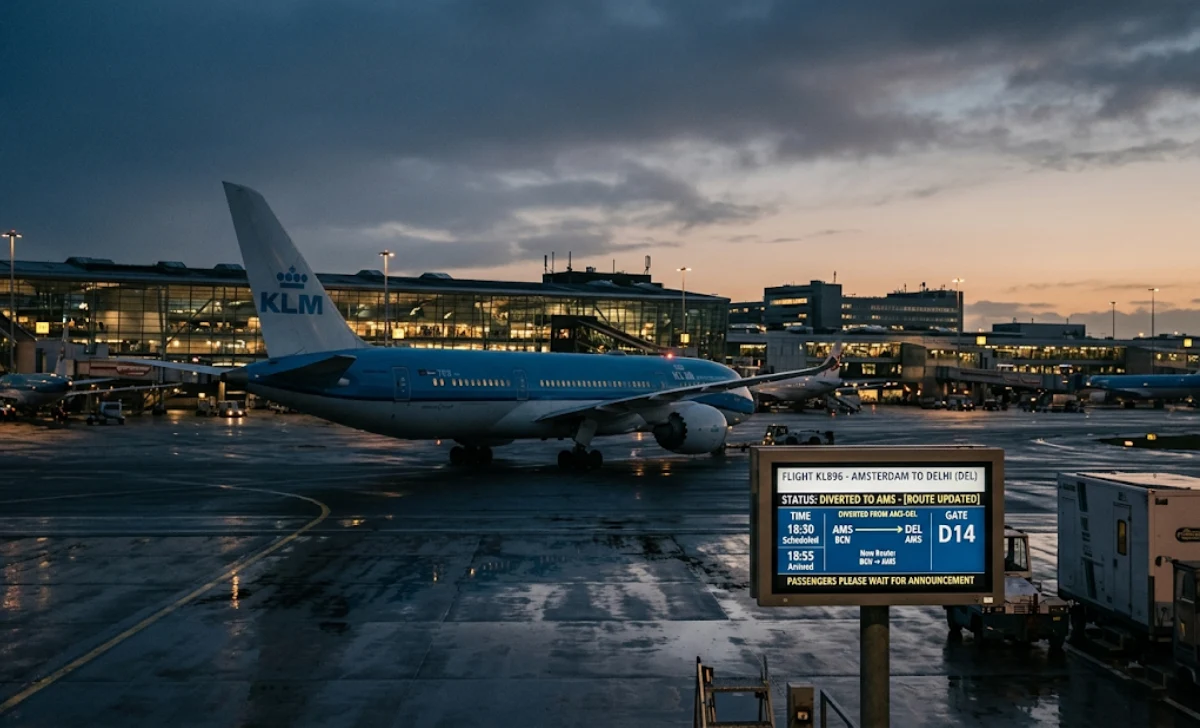
There’s a specific kind of dread that hits when your flight stops going where it’s supposed to. You’re somewhere over the Atlantic, hours from home, and suddenly the pilot comes on and says you’re not landing in Atlanta. You’re landing in Amsterdam.
That’s exactly what happened to passengers on Delta flight DL139, the Venice to Atlanta service that diverted to Amsterdam Schiphol—and if you’re searching for this because it happened to you, or because you fly this route regularly, this breakdown is for you.
I’ve been following airline disruptions and passenger rights for years. This one caught my attention because it wasn’t just a story about a delayed flight. It was a story about how badly travellers need to be prepared—and how little most airlines tell you in the moment.
What Actually Happened on Delta DL139
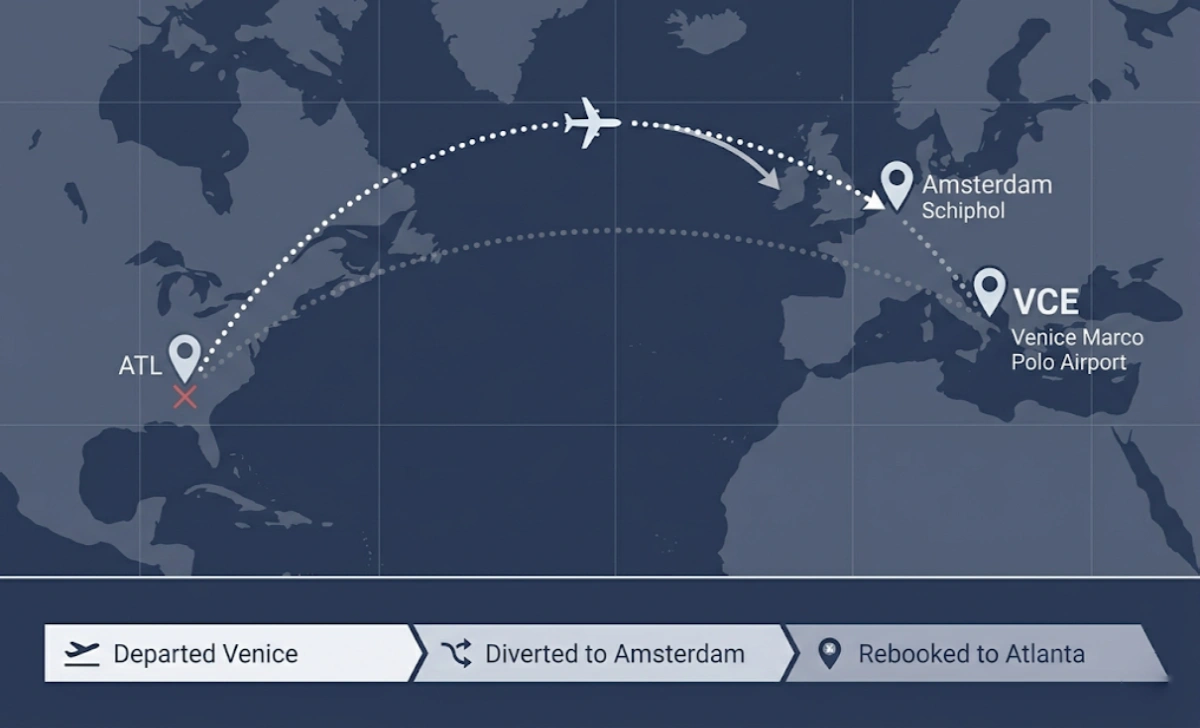
Delta flight DL139 operates between Venice Marco Polo Airport (VCE) and Hartsfield-Jackson Atlanta (ATL). It’s a long transatlantic haul—not a short hop. When something goes wrong on a flight like that, the consequences aren’t just inconvenient. They follow you home for days.
On the day of the Delta DL139 Venice Atlanta Diversion Amsterdam, the flight departed Venice as scheduled. Somewhere over the Atlantic—or before crossing entirely—the crew made the call to reroute. The plane landed at Amsterdam Schiphol (AMS) instead of continuing to Atlanta.
The publicly stated reason pointed to a technical issue, though Delta’s official communication stayed vague. That vagueness is something passengers have criticised consistently, and honestly, it’s worth naming directly. When you’re sitting in an unexpected airport at 2 a.m. with kids and a connection you’ve already missed, “technical issue” doesn’t cut it.
What passengers dealt with in those first few hours: no clear timeline, limited gate updates, long lines, and a slow trickle of information about hotels and rebooking. Some travellers took to social media in real time, posting photos of packed waiting areas at Schiphol and tagging Delta directly. Several posts described the experience as organised chaos at best.
Worth noting too: many passengers on this route aren’t just flying home. A good number are extending an Italian trip—wrapping up time in places like the volcanic coastline of Mongibello before heading back to the U.S. When a diversion hits, it doesn’t just disrupt a flight. It unravels everything built around it.
Why Amsterdam? Here’s the Real Reason
Amsterdam Schiphol wasn’t a random choice. It’s one of the most prepared airports in Europe for exactly this kind of situation.
Schiphol has long-haul gate capacity, 24-hour customs, an on-site hotel, and ground crews trained for unplanned arrivals. It also happens to be a KLM hub—and KLM is Delta’s main transatlantic partner under the SkyTeam alliance. That means Delta has actual staff and resources there, not just a rental counter and a phone number.
For a Delta flight Venice Atlanta diversion, Amsterdam is genuinely the smartest landing option when something goes wrong mid-route. Other airports closer to the midpoint—say, Shannon or Reykjavik—have far less capacity to handle 200+ passengers who all need food, rebooking, and potentially a bed.
The argument you’ll sometimes hear is that airlines pick diversion airports based on cost rather than passenger comfort. That’s partly true. But in this case, the choice made sense operationally for travelers too. Schiphol’s connections back to Atlanta are frequent, and Delta’s partnership with KLM gives them far more rebooking flexibility than a smaller airport would.
What DL139 Passengers Went Through
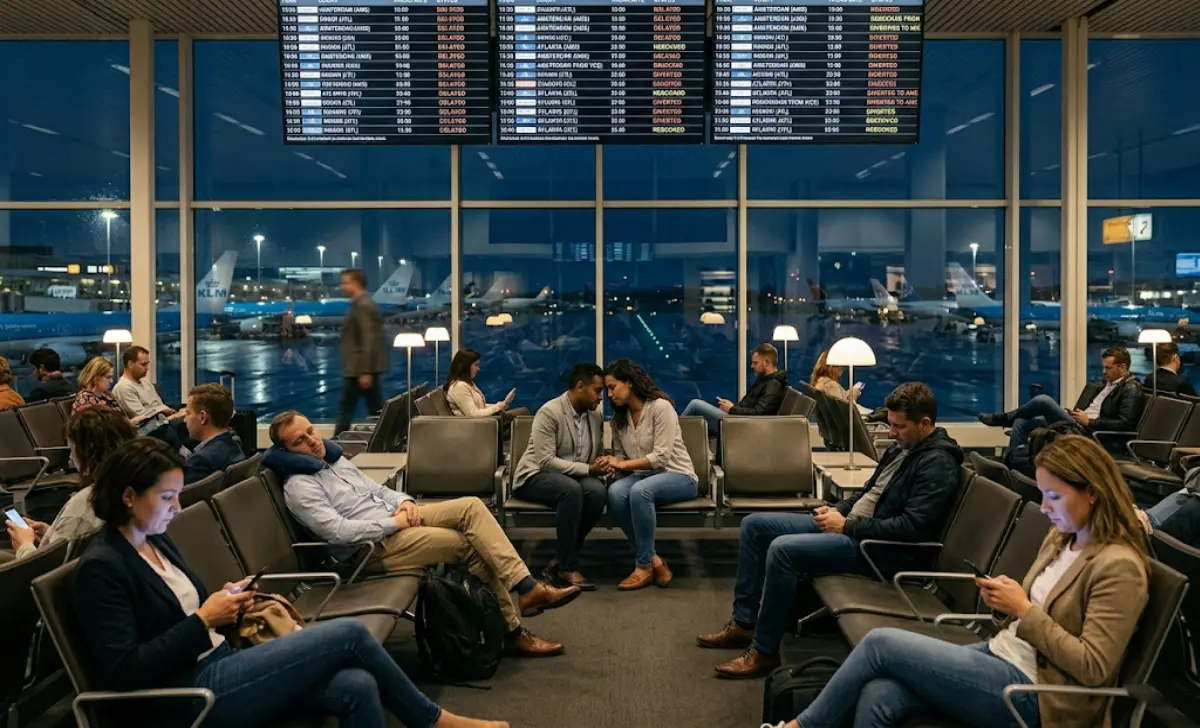
The real story of any diversion is what happens after the wheels touch down somewhere you didn’t expect.
DL139 passengers’ experience ranged widely depending on where they were seated, how quickly they got to the gate, and whether they had Delta’s app active on their phone. Some travellers reported being rebooked on a continuing flight to Atlanta within a few hours. Others waited 8 to 12 hours total before reaching their final destination.
Meal vouchers were distributed, but not immediately. Hotel rooms were offered for those who needed them overnight, though the process for claiming them was confusing, especially for passengers who didn’t speak English fluently or weren’t comfortable navigating a foreign airport alone.
One traveller described it this way in an online forum: they had a connecting flight in Atlanta that they’d already missed before the plane even landed in Amsterdam. Delta’s app showed the new flight before the gate agent had any information. Another passenger travelling with two young children said the hardest part wasn’t the delay—it was not knowing how long the delay would be.
That uncertainty is the part airlines consistently handle poorly. And it’s the part that sticks with people.
Delta Diversion Compensation: What You’re Actually Owed
This is where most passengers feel left in the dark, and it’s also where knowing the rules ahead of time makes a real difference.
Because the Delta DL139 diversion Amsterdam involved a flight originating in Venice—an EU airport—European passenger protection rules apply. Specifically, EU Regulation 261/2004 (EU261) covers what you’re entitled to when a flight is significantly disrupted.
Here’s what EU261 typically covers in a diversion scenario:
- Right to care: Meals and refreshments during the wait, hotel accommodation if you need to stay overnight, and transportation between the airport and the hotel.
- Right to reimbursement or rerouting: If your final destination changes or the delay pushes you past 5 hours total, you can ask for a full refund of your ticket instead of continuing the journey.
- Cash compensation: This is the one most people don’t realise exists. If the delay at your final destination exceeds 3 hours and it wasn’t caused by extraordinary circumstances (like severe weather), you may be entitled to between €250 and €600, depending on flight distance. Venice to Atlanta qualifies for the highest tier.
Step-by-step: How to file an EU261 claim with Delta
- Save everything—boarding pass, new flight confirmation, receipts for any meals or transport you paid out of pocket.
- Note the actual arrival time at your final destination (ATL), not Amsterdam.
- Go to Delta’s website within 30 days and submit through their Customer Care form. Reference EU Regulation 261/2004 explicitly.
- If Delta denies or ignores your claim within 6–8 weeks, escalate to the Italian Civil Aviation Authority (ENAC) since the flight originated in Venice.
- As a last option, a third-party claims service (like AirHelp or Flightright) can pursue it for a percentage of the payout—useful if Delta isn’t responding.
Not everyone got their compensation right away after this diversion. Some passengers had to follow up multiple times. The key is documenting everything from the moment the diversion is announced.
How to Prepare Before Your Next Long-Haul Delta Flight
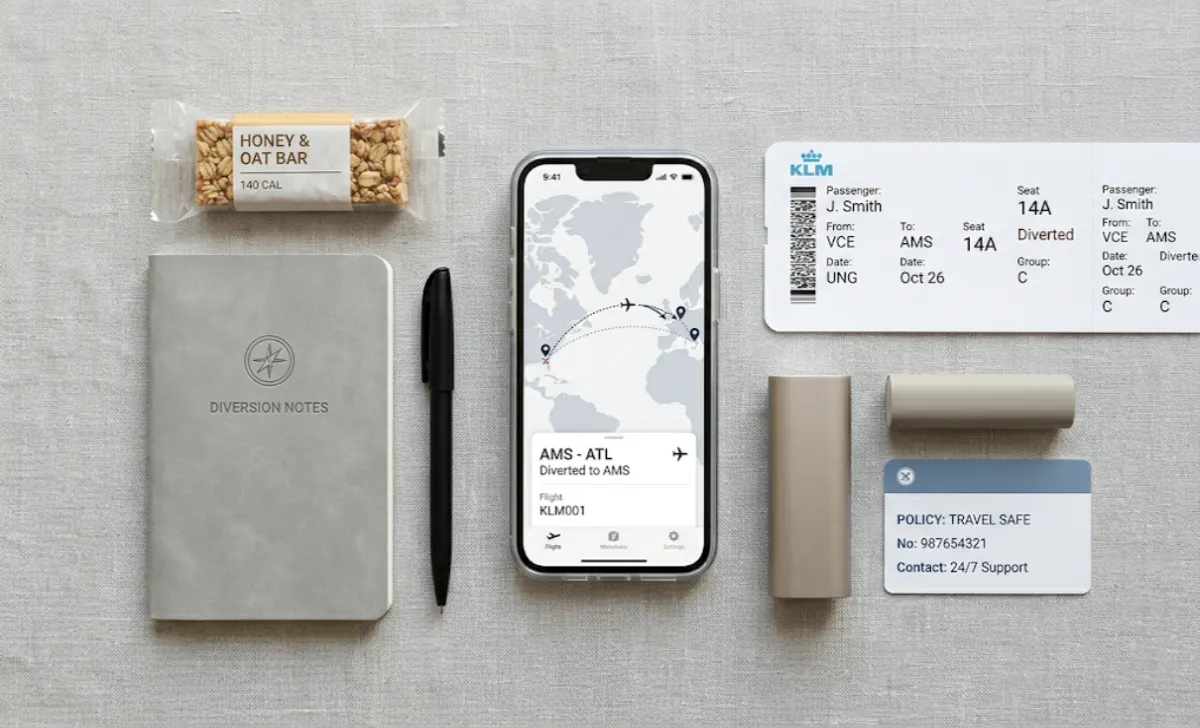
The most useful thing I can tell you after following incidents like this is that preparation matters more than anything the airline does in the moment. Here’s what actually works:
Before you fly:
- Download the Delta app and enable push notifications. In a diversion, the app often updates before gate agents do.
- Screenshot your itinerary and boarding pass—both outbound and any connections. Apps reset after rebooking.
- Get travel insurance that explicitly covers diversions and missed connections. Check the fine print: some policies only cover cancellations, not diversions. The same principle applies whether you’re on a transatlantic flight or budgeting for something like the Everest Base Camp trek—good insurance isn’t optional when travel gets complicated.
- Pack a small power bank in your personal item. Always.
What to carry on every transatlantic flight:
- A snack that will last several hours (airport food gets expensive and closes late at night)
- A portable phone charger
- Any prescription medication in your carry-on, never checked
- A list of your travel insurance policy number and the claims phone number
If your flight diverts:
- Stay near the gate area until you have a confirmed rebooking in hand or on your app.
- Ask two things immediately: “Will we continue on this aircraft?” and “Are hotel or meal vouchers available now?”
- Take a photo of your original boarding pass before it disappears from the app.
- Check Schiphol’s app (or whichever airport you land in) for gate and connection info—sometimes faster than the airline’s own updates.
What This Means for the Venice-Atlanta Route Going Forward
One flight doesn’t define a route, and it’s worth saying that clearly. The Venice Atlanta flight delay situation with DL139 shouldn’t put anyone off flying this connection. It’s a well-travelled transatlantic route with generally strong on-time performance.
But there are real patterns worth watching. Southern European to U.S. East Coast routes have seen slightly higher disruption rates recently—partly because of tighter crew scheduling rules that went into effect in 2025, and partly because of increased air traffic volume as summer travel numbers continue to climb.
What airlines are working through right now is a system that has very little slack. Flights are fuller, crews have less buffer time between assignments, and any domino effect from earlier delays can ripple into a diversion decision faster than it would have five years ago.
This matters for adventure travellers, especially. Someone routing through Venice on the way home from a high-altitude trip—say, after summiting Lobuche Peak in Nepal and continuing west—has an itinerary with almost no room for error. A diversion mid-route doesn’t just cost hours. It can collapse an entire multi-leg journey built around tight connections.
Over the next few years, expect regulators on both sides of the Atlantic to tighten diversion communication requirements. The EU is already reviewing how airlines notify passengers in real time, and the U.S. Department of Transportation has proposed stricter rebooking requirements when passengers land somewhere that isn’t their destination.
For travellers, that’s actually good news. More accountability usually follows more incidents. And incidents like Delta DL139 diversion Amsterdam are exactly the kind that get regulators moving.
Final Thought
Flying long-haul in 2026 means accepting that things won’t always go exactly as booked. Schedules are tight, airspace is full, and the margin for the unexpected has gotten smaller. That’s not a reason to avoid flying—it’s a reason to be a slightly more prepared traveller.
The Delta DL139 diversion in Amsterdam wasn’t a disaster. But for the passengers on board, it was stressful, confusing, and costly in ways that good preparation could have softened. Know your rights under EU261. Keep your documents. Have travel insurance that actually covers disruptions.
And next time you’re on a long transatlantic flight, maybe keep a granola bar in your bag. Sometimes that’s the thing that actually saves your day.
FAQs
Why did Delta DL139 divert to Amsterdam instead of continuing to Atlanta?
The official reason cited was a technical issue on board. The crew followed safety protocol and chose the closest well-equipped airport for the situation. Amsterdam Schiphol was the right call given its capacity and Delta’s existing presence there through its KLM partnership.
What compensation did Delta offer passengers on DL139?
Delta provided meal vouchers, hotel accommodation for those who needed it, and rebooked passengers on the next available Atlanta service. Under EU261 rules—which apply because the flight originated in Venice—passengers may also be entitled to cash compensation of up to €600 if the final arrival in Atlanta was delayed more than 3 hours and the cause wasn’t extraordinary circumstances.
How long were the delays for the Venice Atlanta flight via Amsterdam?
Delays varied. Some passengers reached Atlanta within a few hours of the original scheduled arrival. Others reported total door-to-door delays of up to 12 hours, depending on when they were rebooked and whether they needed overnight accommodation.
What should I do if my Delta transatlantic flight diverts?
Stay near the gate, check the Delta app immediately, ask about meal and hotel vouchers, and document everything—boarding pass, receipts, and new flight details. File an EU261 compensation claim through Delta’s website within 30 days if your flight originated in Europe, and your delay at the final destination was 3 or more hours.
Is Amsterdam a common diversion point for Atlanta-bound flights?
Yes. Schiphol is one of the go-to diversion hubs for transatlantic flights because of its infrastructure, staffing, and airline partnerships. It’s not specific to Delta—many carriers use it for the same reason.
Disclaimer: This article is based on publicly available information and general aviation knowledge. Specific flight details may vary. For official compensation claims, contact Delta directly or consult a licensed travel advisor.