




Spaietacle is the practice of designing spaces — physical or digital — where people don’t just observe but actively participate and remember. It combines spatial design with deliberate emotional intent, using sensory engagement, narrative structure, and participatory elements to produce experiences that create specific feelings rather than simply deliver information.
Spaietacle combines “space” and “spectacle” to describe immersive experiences where people don’t just observe — they actively participate and remember. Used across physical design, digital platforms, and content strategy, it marks a shift from passive viewing to deliberate emotional involvement.
What Is Spaietacle?
Most new concepts come with one clean definition. Spaietacle doesn’t. That’s not a weakness — it’s the point.
The term currently appears in three connected contexts: as a design philosophy, a digital platform concept, and a content and marketing strategy. Each use shares the same core idea: modern audiences no longer want to just see something. They want to feel it, move through it, and carry it with them.
At its foundation, Spaietacle describes the deliberate construction of experiences that engage people on multiple levels at once — spatial, emotional, sensory, and participatory.
Where the Word Comes From
The word fuses two familiar ideas:
- Space — the physical or digital environment where something happens
- Spectacle — something extraordinary that commands attention
Together, they produce something neither term captures alone. A space without spectacle is just a room. Spectacle without space is just noise. Spaietacle is what happens when the two are designed together — when the where and the wow work as a single system.
The Three Ways People Use the Term
- Design philosophy — environments architected to produce specific emotional responses: calm, curiosity, wonder, or joy
- Digital platform concept — creator-driven spaces where audiences actively engage rather than passively consume
- Content and marketing strategy — presenting information or ideas in ways that prioritise memory and emotional impact over raw data delivery
These aren’t contradictory readings. They’re the same principle applied at different scales.
Why This Concept Has Weight
The timing isn’t accidental.
Two shifts have converged. First, audiences have become numb to visual volume. Social feeds, ads, and content platforms have trained people to scroll past anything that doesn’t immediately create a feeling. Second, technology — spatial computing, AR, and AI-driven personalisation — has made immersive design more accessible than it was a decade ago, when only major brands or cultural institutions could afford it.
The result: growing demand for experiences that actually stick. Not just experiences that are seen, but ones that are felt.
This connects to a well-established idea. In their 1999 book The Experience Economy, B. Joseph Pine II and James Gilmore argued that consumers would progressively value experiences over products or services. That prediction has been validated across industries. What Spaietacle adds is a design vocabulary for this moment — when experience is no longer a differentiator but a baseline expectation.
The practical question has shifted. Builders and creators are no longer asking, “How do we show people our product?” They’re askin’,g “How does it feel to be inside our world?”
The Core Elements of a True Spaietacle
Not every engaging experience qualifies. A well-built spaietacle typically contains most of the following:
- Intentional sensory engagement — light, sound, spatial layout, and sometimes scent or texture are chosen for a specific effect, not selected by default
- Participatory structure — the audience is a character in the experience, not a spectator of it
- Narrative thread — a clear story, message, or emotional arc gives the experience meaning rather than mere stimulation
- Environmental depth — the space itself communicates; walls, distances, and transitions carry information that the viewer receives without being told
- Memorability by design — built to leave a specific impression, not just a general positive feeling
What separates Spaietacle from ordinary immersive design is the specificity of intent. Random stimulation is not Spaietacle. A carefully constructed arc — from entry to emotional peak to exit — is.
The psychologist Daniel Kahneman’s peak-end rule is relevant here: people judge experiences primarily by how they felt at the peak moment and at the end, not by the average of every moment. Spaietacle design takes this seriously. It engineers the peak and controls the exit.
How Spaietacle Works Across Industries
Art and Entertainment
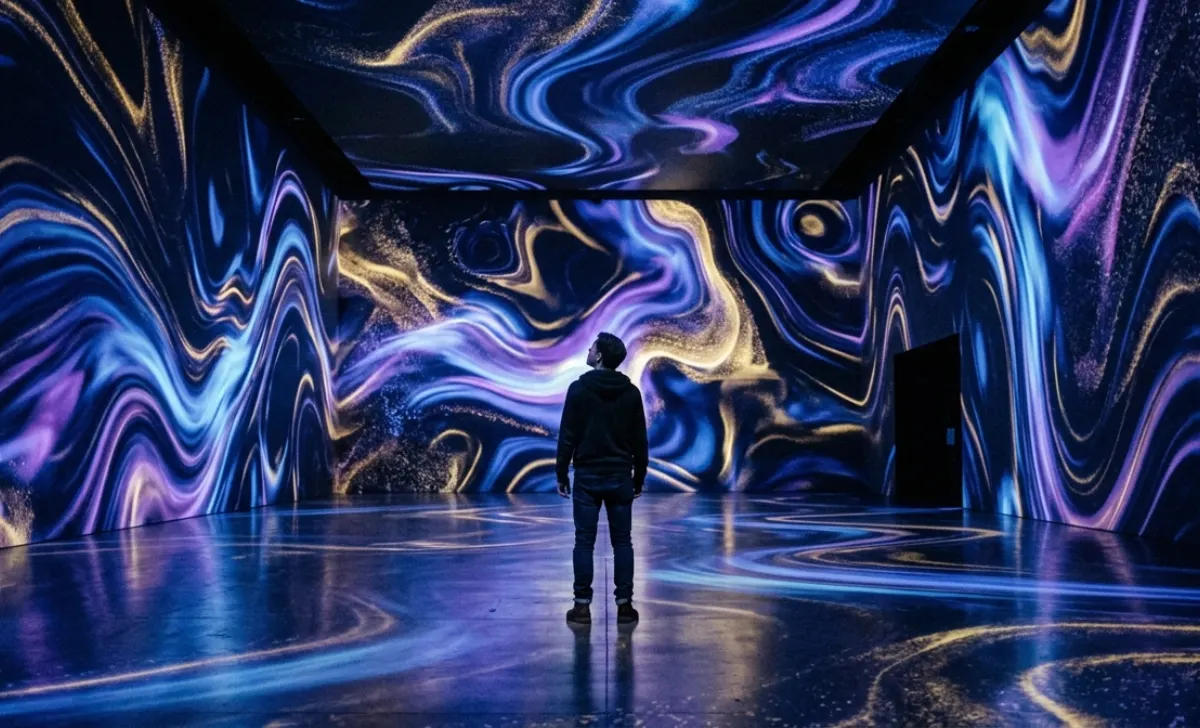
Immersive art installations are the most visible expression of the concept. teamLab’s Borderless and Planets exhibitions in Tokyo place visitors inside moving, reactive digital environments — the artwork changes in response to their presence. That’s not a feature. That’s the entire point.
Meow Wolf, the Santa Fe-based art collective, built permanent immersive narrative environments where visitors move through interconnected physical spaces filled with original art, hidden rooms, and story fragments they piece together themselves. Attendance figures for their Denver location, House of Eternal Return, exceeded projections significantly in its first year — suggesting that demand for this type of experience is real and measurable, not just aspirational.
Live performance has moved in the same direction. Theatre productions that place audiences inside the narrative — “Sleep No More” by Punchdrunk being the most cited example — and festivals designed to guide emotional flow through physical choreography are all working within Spaietacle logic.
Digital Platforms
A platform is not just a place to post content. It’s a space with an emotional atmosphere. Creator platforms that build strong community identity, a clear navigational philosophy, and participatory features — live sessions, collaborative projects, real-time feedback — are building digital Spaietacles even if they don’t use the term.
The distinction between platforms that people use and platforms people feel at home in is increasingly the difference between retention and churn.
Marketing and Brand Experience
Brand strategists have worked with Spaietacle thinking under different names — experiential marketing, sensory branding, brand worlds. The logic is the same: create an environment so precisely tuned to your audience’s emotional expectations that the product becomes secondary to the feeling it produces.
Apple’s retail stores are the most studied example. The layout, material choices, lighting, and staff choreography are not aesthetic decisions. They’re emotional engineering. The goal is not to sell a phone in a shop — it’s to create an encounter with a belief system.
Spaietacle vs. Traditional Experience Design
| Dimension | Traditional Experience Design | Spaietacle |
|---|---|---|
| Primary goal | Functional usability | Emotional memorability |
| Audience role | Observer or user | Active participant |
| Design priority | Clarity and efficiency | Depth and feeling |
| Success metric | Task completion | Emotional residue |
| Sensory engagement | Visual-first | Multi-sensory |
| Narrative | Optional | Structural requirement |
Traditional experience design solves problems. Spaietacle creates impressions. The most effective environments do both — function serves as the floor, feeling serves as the ceiling.
How to Apply Spaietacle Thinking Practically
You don’t need a large budget or a warehouse filled with projectors. The principles scale.
For content creators:
- Start with the specific feeling you want readers or viewers to leave with, then build every element toward that end
- Use structure — pacing, white space, visual rhythm — as an emotional instrument, not just an organisational tool
- Design the journey through your content as a sequence with a clear peak moment, not a list of points to cover
For physical space designers:
- Map the emotional arc of someone moving through the space before specifying materials or layout
- Treat transitions between areas as active communicative moments — what does someone feel as they move from one zone to another?
- Constrain sensory input to what is deliberate. Excess and clutter reverse the effect.
For digital product builders:
- Decide what emotion your interface should consistently produce — confidence, calm, excitement, trust — and test every design decision against that target
- Design micro-interactions (hover states, loading animations, transitions) as part of a coherent emotional system, not as isolated flourishes
- In user research, test for feeling, not only for usability
The simplest version: define the emotion first. Design backwards from it.
Real Challenges You Should Know About
Spaietacle is a genuinely useful concept — but it comes with friction that most writing on the topic glosses over.
Cost and coordination. Immersive experiences require aligned design across multiple channels — spatial, sensory, narrative, and temporal. In physical spaces, this is expensive. In digital environments, it requires cross-functional teams working toward a single emotional vision, which is harder to manage than it sounds.
Accessibility. Highly immersive environments can exclude people with sensory sensitivities, mobility limitations, or limited access to the required technology. This isn’t a minor caveat — it’s a design problem that good Spaietacle work addresses from the start, not as an afterthought.
Substance gap. The most common failure: prioritising the experience over the content. An impressive environment built around an empty idea produces one strong moment and then lasting disappointment. The feeling and the substance have to grow together.
Measurement. Emotional impact is harder to quantify than click-through rates. Teams trained on data metrics often struggle to justify Spaietacle investments. Partial frameworks exist — recall studies, Net Promoter Scores tied to specific experience moments, emotional response testing — but no standard methodology has settled yet. This is an open problem.
Conclusion
Spaietacle is a name for something designers and experienced architects have been reaching toward for years: environments — physical or digital — built not to be seen but to be felt and remembered.
The concept matters not because the word is new but because the problem it addresses is growing. As visual noise increases and attention fragments further, the experiences that cut through will not be louder or more saturated. They will be more intentional. More specific about the emotion they’re after. More disciplined about the journey from entry to exit.
That’s the practical value of Spaietacle thinking: it gives you a framework to ask better questions before you build.
FAQ
What is Spaietacle in simple terms?
Spaietacle is the practice of designing spaces — physical or digital — that people don’t just move through, but actively feel and remember. It combines spatial design with deliberate emotional intent to turn ordinary environments into experiences that stick.
Is Spaietacle an established industry term?
Not yet in the formal sense. It’s an emerging concept gaining use across design, digital platforms, and content strategy. The underlying principles it describes — immersive, participatory, emotionally intentional design — are well-established. The specific term is newer.
How is Spaietacle different from experiential marketing?
Experiential marketing is a brand-specific tactic, typically used to promote products through live events or activations. Spaietacle is broader — it’s a design philosophy applicable to any environment or medium where the goal is emotional engagement. Experiential marketing can be a Spaietacle, but Spaietacle is not limited to marketing.
How does Spaietacle connect to the Experience Economy?
Pine and Gilmore’s 1999 framework argued that economic value was shifting from goods to services to experiences. Spaietacle sits within that trajectory — it’s a practical design approach to creating the kind of experiences that the framework predicted would matter. Where the Experience Economy describes why experiences have value, Spaietacle focuses on how to build them.