





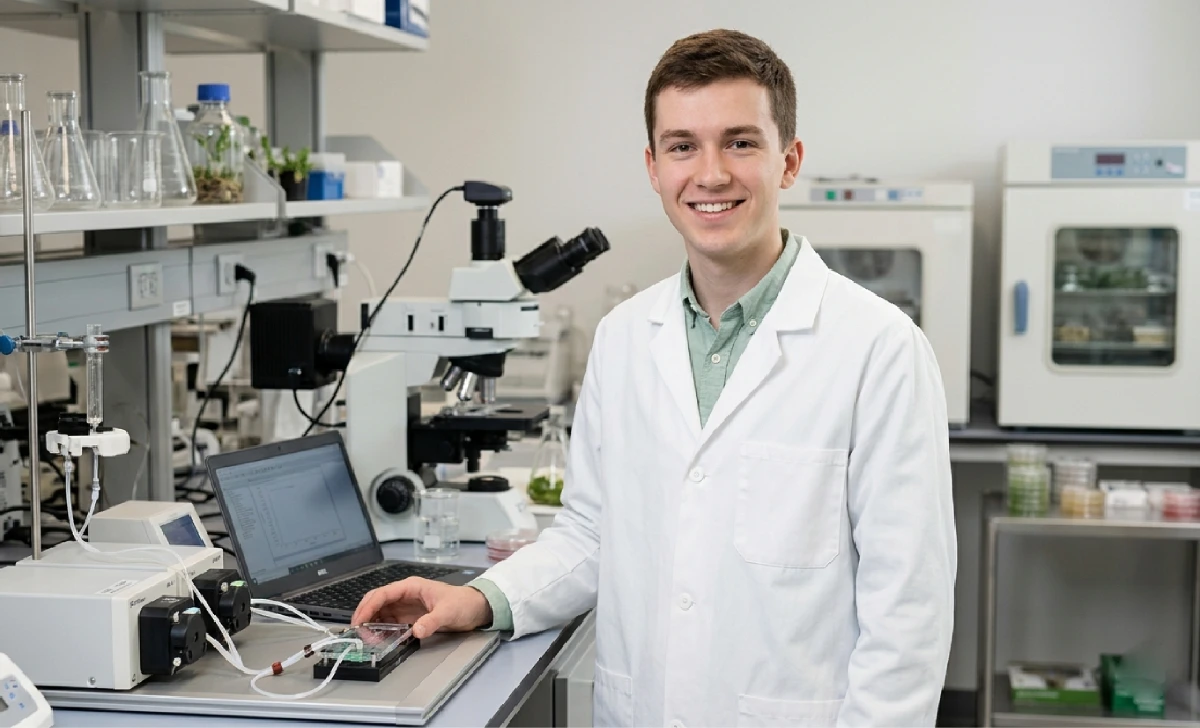
Tanner Jefferson is a doctoral researcher at Oregon State University (OSU) whose work sits at the intersection of laboratory automation and molecular biology. Working in the Megraw Lab under Professor Molly Megraw, Jefferson uses a digital microfluidic (DMF) platform developed by Hewlett-Packard to automate protein synthesis and study how transcription factors bind to DNA.
His research addresses a real bottleneck in gene regulation science: the fact that traditional methods for producing and testing transcription factor proteins are slow, reagent-heavy, and prone to variability introduced by manual handling. By running these experiments on a programmable chip roughly the size of a credit card, Jefferson’s approach reduces material waste, cuts preparation time, and produces more consistent results across experimental runs.
Jefferson has presented his findings at the Oregon Bioengineering Symposium in both 2023 and 2024, documenting a clear progression from foundational protein synthesis protocols to applied transcription factor binding analysis.
Quick Profile
| Detail | Information |
|---|---|
| Full Name | Tanner Jefferson |
| Role | PhD Researcher |
| University | Oregon State University |
| Department | Botany and Plant Pathology |
| PhD Start Year | 2021 |
| Research Advisor | Professor Molly Megraw |
| Lab | Megraw Lab, OSU |
| Research Focus | Digital microfluidics, protein synthesis, transcription factor analysis, synthetic biology |
| Platform | HP Digital Microfluidics (DMF) |
| Industry Partner | Hewlett-Packard (HP) |
| Presentations | Oregon Bioengineering Symposium 2023, 2024 |
Academic Background and Lab Environment
Jefferson enrolled in OSU’s doctoral program in 2021, joining the Department of Botany and Plant Pathology — a placement that connects his molecular biology work to the practical questions of plant science, including how crops respond to disease and environmental stress.
His departmental home gives him access to OSU’s Centre for Genome Research and Biocomputing (CGRB), an interdisciplinary unit that supports research in molecular biology, genomics, and computational modelling. This dual access — to both experimental resources and computational infrastructure — is central to how the Megraw Lab operates.
The Megraw Lab’s primary focus is understanding transcriptional networks: the molecular systems that control which genes get switched on or off in an organism, and when. Jefferson’s experimental role is to generate biological data that can be used to test and validate the lab’s computational models. The DMF platform he works with is the instrument that makes this data generation faster and more consistent than traditional bench methods would allow.
What Is Digital Microfluidics — and Why Does It Matter for This Research?
Digital microfluidics (DMF) is a laboratory technology that moves tiny liquid droplets across a programmable chip surface using electrical signals. The underlying mechanism is called electrowetting-on-dielectric (EWOD): electrodes embedded beneath the chip surface apply and release charges in sequence, effectively pushing and pulling droplets along a defined path — no physical pipette required, no channels, no valves.
How EWOD Works in Practice
- A droplet of biological sample is placed on the chip surface.
- The control system activates electrodes in a sequence, creating a localised charge that attracts the droplet forward.
- The droplet moves along the programmed path, merging with reagent droplets at designated positions.
- Each merge triggers a chemical reaction — for example, adding a translation mix to a DNA template to begin protein synthesis.
- The completed reaction product is collected for analysis.
This entire sequence — which would typically require a trained technician, multiple tubes, pipettes, and manual timing — happens automatically on a device small enough to hold in one hand.
Practical Advantages Over Traditional Bench Methods
| Parameter | Traditional Method | DMF Method |
|---|---|---|
| Reagent volume per experiment | Microlitres to millilitres | Nanolitres |
| Manual handling steps | 10–20+ | 2–3 (setup and retrieval) |
| Experiment-to-experiment variability | Higher (human-introduced) | Lower (automated sequence) |
| Time to complete a protein synthesis run | Hours, with active supervision | Automated, operator-free |
| Parallel experiments possible | Limited by technician capacity | Multiple simultaneous runs on one chip |
For a research lab studying transcription factors — where experiments need to be run many times to generate statistically meaningful data — these differences are significant. Fewer manual steps mean fewer opportunities for error. Smaller reagent volumes mean lower costs per experiment. Automated sequences mean the same result every time, which is a prerequisite for any finding to be reproducible.
Jefferson’s Three Research Areas
1. Automated Protein Synthesis
Proteins are the functional molecules that carry out virtually every process in a living cell. Producing them in a laboratory — in vitro protein synthesis — is a fundamental technique in molecular biology, but it involves multiple sequential steps: mixing a DNA template with transcription machinery, adding translation components, controlling temperature, and eventually isolating the finished protein.
Jefferson’s research develops protocols for running this process on HP’s DMF chip. The goal is twofold: first, to demonstrate that the chip can reliably produce proteins with the same quality as bench methods; second, to make the process repeatable enough that results can be trusted across many experimental runs.
Practical example: A researcher studying a plant stress-response gene needs to produce the transcription factor protein that controls that gene. Using a conventional approach, they might spend two to three hours on bench preparation for a single protein batch. Using Jefferson’s DMF-based protocol, the same synthesis runs on the chip in a fraction of the time, with less reagent, and with automated documentation of each step.
2. Transcription Factor Analysis and DNA-Binding Studies
Transcription factors are proteins that act as molecular switches — they bind to specific short sequences of DNA near a gene and either activate or suppress that gene’s expression. Understanding which sequences a given transcription factor binds to, and how strongly, is central to understanding how organisms regulate growth, stress response, and defence.
At the 2024 Oregon Bioengineering Symposium, Jefferson presented a poster on using HP’s DMF platform to both synthesise transcription factor proteins and then run binding assays on-chip — testing how those proteins interact with target DNA sequences.
Why running this on DMF matters: Traditional binding assays — such as electrophoretic mobility shift assays (EMSAs) or fluorescence polarisation tests — require relatively large quantities of purified protein and multiple manual preparation stages. On a DMF chip, the synthesis and binding test can be linked in a single automated sequence, using far smaller volumes and yielding results faster.
Practical example: Testing whether a transcription factor binds to 10 different DNA sequence variants conventionally requires 10 separate protein preparations, 10 assay setups, and hours of technician time. A DMF protocol can queue multiple droplet paths on a single chip run, testing all 10 variants in parallel.
3. Synthetic Gene Expression Systems
Jefferson also works with synthetic gene expression constructs — laboratory-designed DNA sequences that model how real genes function without the complexity of a complete organism. These constructs isolate specific regulatory relationships, letting researchers ask targeted questions such as: “Does this transcription factor activate or suppress expression when it binds to this sequence?”
This work is directly useful to the Megraw Lab’s computational models. A model of a transcriptional network needs experimental data to calibrate its predictions — Jefferson’s constructs provide that data in a controlled, interpretable form.
The HP Digital Microfluidics Platform
Jefferson’s research is conducted on a proprietary DMF system developed by Hewlett-Packard. This is not standard laboratory hardware — it represents a commercial technology that HP has developed for life science applications, and Jefferson’s doctoral project is one of the scientific validation use cases for that platform.
The collaboration is practical on both sides:
- Jefferson and OSU gain access to hardware that would not otherwise be available in a university biology lab.
- HP gains peer-reviewed research data demonstrating what the platform can do in real scientific applications — data that informs future product development and supports commercial positioning.
Jefferson’s role in this arrangement is to develop protocols: specific, documented sequences of steps that make the DMF platform produce reliable results for protein synthesis and binding analysis. These protocols are the transferable output of his research — a method that other researchers could, in principle, adopt for their own gene regulation studies.
Oregon Bioengineering Symposium: Research Presentations
Jefferson has built a two-year public record of his research through presentations at the Oregon Bioengineering Symposium.
2023 Presentation — Protein Synthesis via DMF
Jefferson’s first symposium presentation focused on establishing that HP’s DMF platform could run protein synthesis protocols reliably. This is proof-of-concept work: demonstrating that a technology built for one purpose (automated fluid handling) can be adapted for a specific biological application (cell-free protein production).
The significance: before this kind of validation, there was no documented evidence that this platform could handle the sensitivity and precision required for in vitro protein synthesis. Jefferson’s 2023 work provided that evidence.
2024 Presentation — Transcription Factor Synthesis and DNA Binding
The 2024 poster extended the 2023 foundation in a meaningful direction. Having shown that the platform can produce proteins, Jefferson demonstrated that it could also analyse those proteins’ functional behaviour — specifically, their binding to DNA sequences relevant to gene regulation.
This progression — from “the tool works” to “the tool produces scientifically useful data” — is the expected arc of early doctoral research and represents a credible advancement in the application of DMF to gene regulation science.
Why This Research Direction Has Real Significance
The broader shift this work represents is the move from manual, labour-intensive laboratory procedures toward programmable, miniaturised systems that can run complex biology experiments with less human involvement. This is happening across many areas of biological science, and Jefferson’s work is a specific instance of it applied to transcription factor research.
For plant biology specifically — the institutional context of Jefferson’s department — transcription factors are directly connected to how crops respond to drought, disease, and temperature stress. Faster, cheaper methods for characterising transcription factor binding have downstream relevance for agricultural research, even if Jefferson’s doctoral work is foundational rather than applied.
For synthetic biology more broadly, cell-free protein synthesis on microfluidic devices is an active research direction. Demonstrating that a commercially available DMF platform can support this work contributes to the evidence base that such platforms are viable for serious molecular biology research.
Conclusion
Tanner Jefferson is a doctoral researcher making specific, technically grounded contributions to an active area of bioengineering. His work uses a commercial digital microfluidic platform in a novel scientific context — applying it to fundamental questions about how transcription factors control gene expression. The two-year arc of his Oregon Bioengineering Symposium presentations shows a clear progression: from establishing that DMF can handle protein synthesis, to demonstrating that it can support meaningful binding analysis.
His research sits at a real intersection: laboratory automation meeting molecular biology, academic research meeting industry hardware development, and computational modelling meeting experimental data generation. Whether the work ultimately produces a body of published findings that extends its influence beyond OSU will be known when his doctoral programme concludes — but the methodological direction is sound, the platform is real, and the scientific questions are worth asking.
For researchers, students, or professionals interested in the application of microfluidic systems to gene regulation science, Jefferson’s work at the Megraw Lab represents a current, live example of how this technology is being tested and refined in a real laboratory setting.
FAQs
What is digital microfluidics, and how is it used in biology?
Digital microfluidics (DMF) is a technology that moves tiny liquid droplets across an electronically controlled chip surface. In biology, it automates multi-step reactions — such as protein synthesis or DNA-binding assays — by programming droplets to merge and react in a precise sequence. This reduces manual handling, decreases reagent use, and produces more consistent experimental results than traditional bench methods.
What is Tanner Jefferson’s PhD research about?
Jefferson’s doctoral research at Oregon State University focuses on using a digital microfluidic platform (developed by Hewlett-Packard) to automate protein synthesis and transcription factor binding analysis. His work is conducted in the Megraw Lab and contributes experimental data to the lab’s computational models of gene regulation.
What is a transcription factor, and why study it?
A transcription factor is a protein that binds to specific DNA sequences and controls whether a gene is switched on or off. Understanding how transcription factors bind to DNA helps scientists decode how organisms regulate growth, stress responses, and disease resistance — questions with implications for medicine, agriculture, and synthetic biology.
What is the Megraw Lab at OSU?
The Megraw Lab, led by Professor Molly Megraw in OSU’s Department of Botany and Plant Pathology, focuses on computational biology — specifically, using data analysis and modelling to understand gene expression regulation. Jefferson’s experimental work generates data that supports and tests the lab’s computational models.
What is EWOD (electrowetting-on-dielectric)?
EWOD is the physical mechanism behind digital microfluidics. Electrodes beneath a chip surface apply electrical charges that alter the surface tension at a droplet’s contact edge, causing the droplet to move toward the charged electrode. By activating electrodes in sequence, a control system can move, merge, and split droplets along any programmed path — with no physical channels or pumps needed.
What is cell-free protein synthesis?
Cell-free protein synthesis is a method of producing proteins in a test tube (or on a chip) rather than inside living cells. A DNA template is combined with transcription and translation machinery extracted from cells, producing the target protein without growing a cell culture. It is faster than cell-based methods and useful for producing proteins that are difficult to express in living organisms.
Has Tanner Jefferson published peer-reviewed research?
As of 2024, Jefferson’s documented research output consists of two poster presentations at the Oregon Bioengineering Symposium (2023, 2024). His doctoral thesis is still in progress, with peer-reviewed publications expected as the programme advances toward completion.
Why is Oregon State University’s Botany and Plant Pathology department relevant to synthetic biology?
The department’s focus on plant molecular biology connects naturally to synthetic biology questions about gene regulation, as many of the transcription factors studied in this context have plant-biology applications — particularly in crop stress response and disease resistance. The department also has access to OSU’s Centre for Genome Research and Biocomputing, which provides computational infrastructure for genomics and modelling research.