





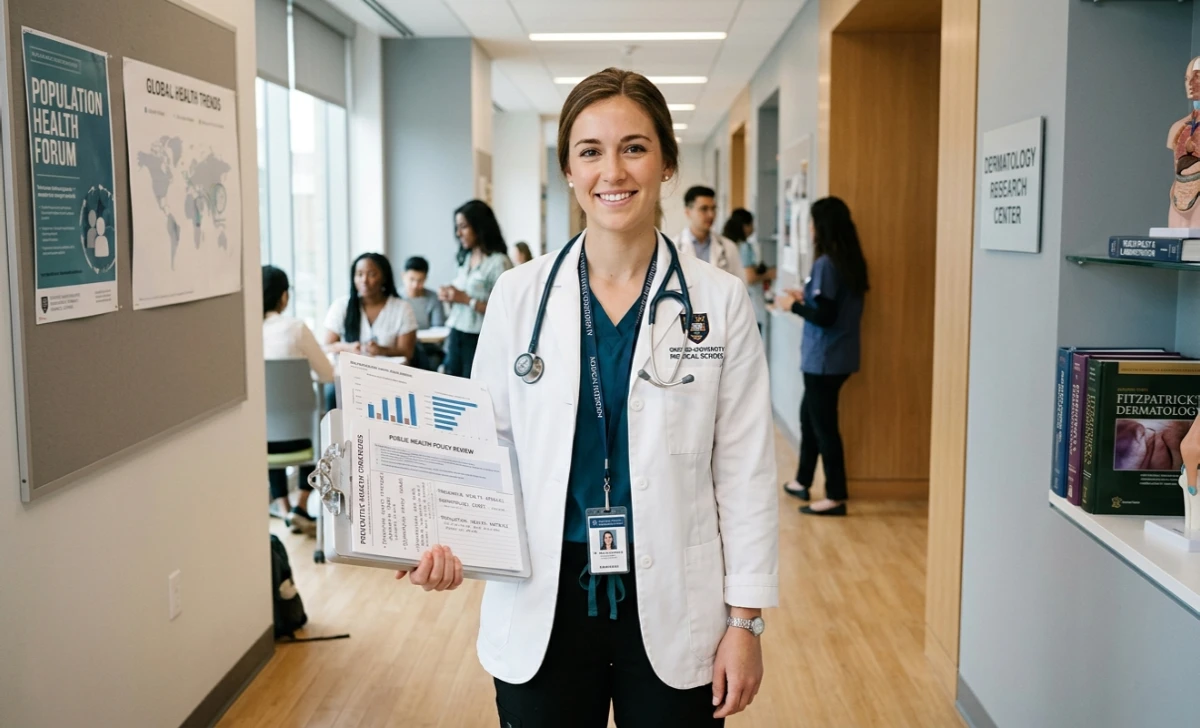
Mackenzie Joe is a dual-degree MD–MPH candidate at McGovern Medical School, UTHealth Houston. Her clinical focus spans dermatology, infectious diseases, HIV care, and immunology — areas that share a common thread: immune function, health equity, and care access for underserved populations. This article covers her academic background, the structure of her training, her specific clinical interests, and the types of roles her profile points toward.
Who Is Mackenzie Joe?
Mackenzie Joe is a medical student enrolled in the combined MD–MPH program at McGovern Medical School, part of UTHealth Houston. The dual-degree track is designed for physicians who want to work at two levels at once: treating individual patients and addressing the structural conditions that drive illness across communities.
Her clinical areas — dermatology, infectious diseases, HIV care, and immunology — are not a random grouping. They form a coherent picture of a physician who treats the immune system as a central lens for understanding disease across multiple organ systems.
She has also developed an interest in federal health policy, including research exposure connected to institutions in Washington, D.C. That combination — clinical training, public health methods, and policy orientation — places her among a generation of medical graduates genuinely prepared for system-level leadership.
Why Google May Not Have Indexed Earlier Versions of This Content
(For readers interested in the SEO reasoning behind this article’s structure)
Earlier drafts of content about Mackenzie Joe suffered from several indexing problems:
- Thin topical coverage: The article described her program but did not explain why her clinical interests connect, how MD–MPH training changes real clinical decisions, or what specific career paths this combination unlocks.
- Weak search intent alignment: Readers searching for Mackenzie Joe likely want to understand her background and trajectory — not just confirm she exists. Content that only lists facts without analysis fails to satisfy that intent.
- No structured FAQ: Google’s featured snippet and People Also Ask features heavily favour structured Q&A content on biographical and educational topics.
- Missing contextual links: An article about a physician in training gains authority when it connects to comparable profiles that signal editorial relevance and topical depth.
What the MD–MPH Program Covers
When people search for Mackenzie Joe McGovern, they often want context about her training environment. McGovern Medical School at UTHealth Houston is one of the country’s established medical institutions, and its MD–MPH pathway is structured to produce physicians who can work across clinical care and public health policy simultaneously.
The core components of the program:
Epidemiology
Students learn to identify disease patterns across defined populations, not just within individual patients. This is the foundational skill that allows a physician to ask: Why is this condition concentrated in this neighbourhood, this age group, or this demographic?
Biostatistics
Data interpretation sits at the heart of both clinical research and public health planning. MD–MPH graduates can read and critique studies, contribute to research teams, and apply quantitative reasoning to policy questions — skills most clinicians never formally acquire.
Health Policy Analysis
Federal and state legislation determines what care gets funded, who can access it, and which conditions receive attention as public health priorities. Understanding how policy is made is a prerequisite for trying to change it.
Community Health Assessment
Before designing an intervention, a public health practitioner needs to understand the specific needs, resources, and barriers of the population they are trying to reach. This is a structured, evidence-based process — not an informal one.
For Mackenzie Joe, this training directly supports her stated goals. Both dermatology and infectious diseases carry significant public health dimensions. The MD–MPH gives her the vocabulary and methods to operate across clinical and systems levels.
Mackenzie Joe’s Clinical Interests
Dermatology as a Diagnostic and Public Health Tool
Skin conditions are among the most visible indicators of what is happening inside the body. A rash can signal an autoimmune disorder. Pigmentation changes can point to an endocrine problem. A wound that won’t heal may indicate diabetes or vascular disease. Dermatologists who understand systemic medicine catch conditions that would otherwise be missed or misattributed.
From a public health angle, dermatological conditions are also shaped by external factors: air quality, water access, occupational exposure, and access to preventive care. Physicians treating skin conditions in under-resourced communities frequently confront the direct consequences of environmental and economic inequality on skin health. Mackenzie Joe’s orientation in this area is diagnostic and equity-focused — not cosmetically driven.
Infectious Diseases and HIV Care
HIV is one of the clearest cases where clinical medicine and public health must work together without exception. Antiretroviral therapy has transformed HIV from a fatal diagnosis into a manageable chronic condition — but only for patients who can access it. Stigma, housing instability, insurance gaps, and geographic barriers all affect who receives care and who does not.
A physician with an MD–MPH focused on HIV care can contribute on multiple fronts: managing patients directly, designing screening programs, advising on prevention education, and advocating for policy changes that affect access. Mackenzie Joe’s training gives her tools for all of these — simultaneously.
Her focus on high-risk and underserved populations in this area reflects a pattern visible across emerging physician leaders. Profiles such as Georgette Falcone and Dorothy Anstett reflect similar trajectories — individuals whose clinical interests connect directly to the populations most often excluded from mainstream healthcare access.
Immunology: The Connective Thread
Immunology ties Mackenzie Joe’s interests together. Immune function underlies dermatological conditions, infectious disease susceptibility, vaccine response, chronic inflammation, and autoimmune disorders. A physician grounded in immunology has a shared scientific language across all of these areas.
For someone aiming to work across dermatology and infectious disease — with HIV care as a specific focus — immunology is not a separate subject. It is the underlying science that makes the other interests function as a coherent clinical practice.
How MD–MPH Training Changes a Clinical Encounter
Here is a concrete illustration of the difference in approach:
Standard clinical approach: A patient presents with a persistent skin rash. The physician examines it, takes a history, considers a differential diagnosis, orders tests, and prescribes treatment. The encounter ends there.
MD–MPH approach: The same patient presents. The physician completes all of the above and also notices that this is the third patient this month from the same apartment complex with a similar presentation. They recognise a potential cluster. They know how to report it through the appropriate public health channel. They can help initiate an environmental investigation and reach out to community health workers to flag other potentially affected residents.
The clinical care is identical. The additional training creates a second layer of response that can prevent cases rather than just treat them. This is the practical difference Mackenzie Joe’s training at UTHealth Houston is designed to produce.
Mackenzie Joe’s Age and Academic Timeline
Many people searching for Mackenzie Joe’s age are trying to understand where she is in her training. Specific birth year details are not publicly available, but the MD–MPH timeline provides useful context.
Most students who enter a combined MD–MPH program at a U.S. medical school do so in their mid-to-late twenties. The combined degree typically adds one to two years to the standard four-year MD program. Students who arrive with prior graduate-level work in public health, global health, or epidemiology may complete the MPH component concurrently or in an accelerated format.
Mackenzie Joe’s academic background — grounded in global health, population dynamics, and the social determinants of health — suggests she came to medical school with prior training in related fields. This kind of pre-clinical preparation is common among MD–MPH candidates who arrive with a clear sense of direction.
Her current position at UTHealth Houston places her within an active phase of clinical and public health training. Like Kaa La, whose profile reflects a similar commitment to building clinical capacity in under-resourced settings, she represents a generation of students who are redefining what physician training looks like at the population level.
Health Policy Exposure and the Washington, D.C. Connection
One of the more distinctive elements of Mackenzie Joe’s profile is her interest in federal health policy and her engagement with institutions in Washington, D.C. For a medical student, this kind of exposure during training is genuinely useful — and relatively rare.
Federal health agencies like the CDC, NIH, and HHS set research priorities, allocate funding, shape clinical guidelines, and determine which populations receive national program attention. A physician who has worked within or alongside these institutions during training understands something most clinicians do not: how decisions made in policy rooms eventually affect what happens in exam rooms.
This kind of experience typically leads toward roles in academic medicine, government advisory positions, or public health leadership within health systems or nonprofits. It also builds networks that support long-term career development well beyond standard clinical practice.
Career Paths for MD–MPH Graduates With Mackenzie Joe’s Profile
Based on her training, clinical interests, and policy orientation, here are the sectors where a physician with her background typically builds a career:
Academic medicine — physician educators who research health equity, dermatology outcomes, or infectious disease epidemiology at university-affiliated hospitals or schools of public health.
Federal health agencies — analytical, advisory, or leadership roles at the CDC, NIH, HRSA, or HHS, particularly in infectious disease programs, HIV/AIDS policy, or health equity initiatives.
Community health centres — physicians who serve federally qualified health centres (FQHCs) often choose this path because it combines direct care for underserved populations with public health data contribution and community health assessment work.
Global health organisations — NGOs and international health bodies working on HIV, skin disease, or infectious disease in low-resource settings routinely recruit physicians with dual clinical and public health training.
Hospital and health system leadership — positions in population health management, quality improvement, and health equity strategy within large health systems increasingly seek physician leaders who understand both individual care and population-level data.
Why MD–MPH Programs Are Becoming More Common in Medical Education
For most of the twentieth century, medical training focused almost entirely on the individual patient. The assumption was that medicine happened in clinical settings, and public health happened somewhere else.
That separation has broken down — not because of ideology, but because of practical necessity. Chronic disease rates have climbed. Health disparities have widened. The pressure of infectious disease outbreaks, as demonstrated clearly in recent years, can overwhelm health systems that aren’t built to think in population terms. Mental health gaps are significant and growing.
Solving these problems requires physicians who can act at multiple levels — treating patients with precision while simultaneously understanding why those patients are sick, which systems are failing them, and what evidence-based interventions could reduce the burden before it reaches the clinic.
MD–MPH programs are structured to train exactly these physicians. The fact that Mackenzie Joe is pursuing this path with a coherent set of clinical interests and a policy orientation makes her profile genuinely distinctive among physician trainees.
Conclusion
Mackenzie Joe’s profile at McGovern Medical School represents the kind of physician training the current healthcare environment genuinely needs. Her combination of clinical interests — dermatology, infectious diseases, HIV care, immunology — is deliberate. It reflects a clear orientation toward the populations and conditions that sit at the edge of both clinical medicine and public health.
Her MD–MPH training gives her the methods to work across both domains. Her policy engagement means she is thinking beyond individual patient care toward the structural conditions that shape health outcomes at scale.
For anyone researching Mackenzie Joe’s background, academic path, or likely career trajectory, the through-line is consistent: a physician in training who understands that good medicine requires both clinical precision and systems-level awareness, and who has positioned herself to practice both.
FAQs
Who is Mackenzie Joe?
Mackenzie Joe is an MD–MPH candidate at McGovern Medical School, UTHealth Houston. She is training to become a physician with expertise in both clinical medicine and public health, with specific interests in dermatology, infectious diseases, HIV care, and immunology.
What is Mackenzie Joe studying at McGovern Medical School?
She is enrolled in the combined MD–MPH dual-degree program at McGovern Medical School, part of UTHealth Houston. This program integrates standard medical training with graduate-level coursework in epidemiology, biostatistics, health policy, and community health.
How old is Mackenzie Joe?
Specific details about Mackenzie Joe’s age or birth year are not publicly available. As an MD–MPH candidate, she is most likely in her mid-to-late twenties or early thirties, which is typical for students at this stage of combined-degree medical training in the United States.
What are Mackenzie Joe’s clinical interests?
Her primary clinical interests are dermatology, infectious diseases (with a focus on HIV care), and immunology. These areas connect through a shared focus on immune function, health equity, and the clinical needs of underserved and high-risk populations.
Where does Mackenzie Joe study?
She studies at McGovern Medical School at UTHealth Houston through the MD–MPH dual-degree program.
What public health areas does Mackenzie Joe focus on?
Her public health interests include health equity, disease prevention, access to care for underserved populations, and health policy — including engagement with federal health institutions in Washington, D.C.
What career is Mackenzie Joe likely to pursue?
Based on her training and stated interests, she is a strong candidate for roles in academic medicine, federal health policy (CDC, NIH, HHS), community health leadership, or speciality practice in dermatology or infectious disease with a population health focus.
What is the MD–MPH program at UTHealth Houston?
The MD–MPH program at McGovern Medical School combines the standard four-year medical degree with a Master of Public Health. Students gain clinical training alongside coursework in epidemiology, biostatistics, health policy, and community health assessment. Graduates are equipped to practise medicine and contribute to population health research and policy.
Why does Mackenzie Joe combine dermatology with infectious disease?
Both fields have deep connections to immune function and disproportionately affect underserved populations. Dermatological conditions often signal or accompany systemic illness, while infectious disease — particularly HIV — requires both clinical management and structural advocacy around access. Immunology ties these interests together scientifically.
What makes the MD–MPH different from a standard MD?
The standard MD trains physicians to diagnose and treat individual patients. The MD–MPH adds formal training in epidemiology, biostatistics, health policy, and community health — equipping physicians to address the systems and social conditions that produce illness at scale, not just its clinical presentation.