




There is a particular kind of artist whose work doesn’t sit still. Royme Socarras is one of them.
Working at the intersection of visual art and music, Socarras has built a practice that draws from his Cuban heritage, engages with urgent social questions, and deliberately refuses to stay in one lane. His murals have sparked conversations in community spaces. His music borrows rhythms from Latin tradition and reshapes them through a contemporary lens. Together, these two bodies of work form a single ongoing statement about identity, belonging, and what culture can carry.
This article covers who Royme Socarras is, how his creative approach developed, what makes his technique distinctive, and why his work is drawing increasing attention from both art communities and wider audiences.
Who Is Royme Socarras?
Royme Socarras is a Cuban-American multidisciplinary artist whose practice spans painting, large-scale murals, mixed-media installations, and music production. His work is anchored in his Latin American heritage while addressing themes that cross cultural lines — inequality, community belonging, environmental responsibility, and human rights.
Unlike artists who specialise in a single medium, Socarras treats music and visual art as two sides of the same conversation. A composition might influence the colour palette of a mural. A painting’s emotional weight might shape the structure of a track. This cross-pollination is not a marketing angle — it reflects how he actually works.
He has been described by those who follow his career as someone more focused on the effect his work has on people than on stylistic consistency or marketable branding. That human-centred priority is visible across every medium he works in.
Cuban Roots and the Making of a Creative Identity
Cultural identity is not a backdrop in Socarras’s work — it is the material itself.
Growing up with strong Cuban roots, he absorbed the layered rhythms of Latin music, the visual richness of Caribbean colour, and the complex histories that his community carried. These early influences didn’t translate into nostalgic references or surface-level aesthetics. They became the foundation for a more specific kind of honesty.
Artists who draw from a lived cultural experience tend to make work that feels grounded rather than constructed. Socarras takes that further: his Cuban heritage is visible in the structural choices he makes — the way he layers sound, the weight he gives to human figures in murals, the balance between joy and difficulty in his subject matter.
Some critics argue that leading with cultural identity can limit an artist’s crossover appeal. The evidence with Socarras suggests the opposite. Specificity, when handled without self-consciousness, often creates the conditions for genuine universality. The more precisely something is true, the more widely it tends to land.
This relationship between personal background and artistic identity is something other emerging artists have explored in interesting ways. Crispy Heaton’s trajectory, for example, shows how a grounded personal story can shape a creative voice that connects far beyond its original context — worth reading for anyone thinking seriously about cultural authenticity in contemporary practice.
How He Works: Music and Visual Art as a Single Practice
The most immediately striking thing about Royme Socarras’s creative practice is that he does not treat music and visual art as separate disciplines.
Most artists establish a primary medium and treat others as side projects or experiments. Socarras works across both with equal intention. The result is a body of work that rewards sustained engagement — the same piece often yields something different on a second encounter, depending on what mood or knowledge you bring to it.
In his visual work, he uses texture, scale, and unexpected material combinations to create murals and mixed-media pieces that reward close inspection. His pieces are built with layers — literal physical layers in the materials, and conceptual layers in the imagery. A viewer can respond to the surface immediately, then return and find more.
In his music, he layers Latin-influenced rhythms with contemporary production, creating tracks that feel familiar and fresh at the same time. The musical approach mirrors the visual one: rhythm and repetition as structural tools, contrast as a way of creating meaning.
The connection between the two is not superficial. A colour palette might be inspired by a particular chord progression. A visual rhythm in a mural might echo a musical phrase from a track made in the same period. For Socarras, the two practices are not parallel — they’re interlocking.
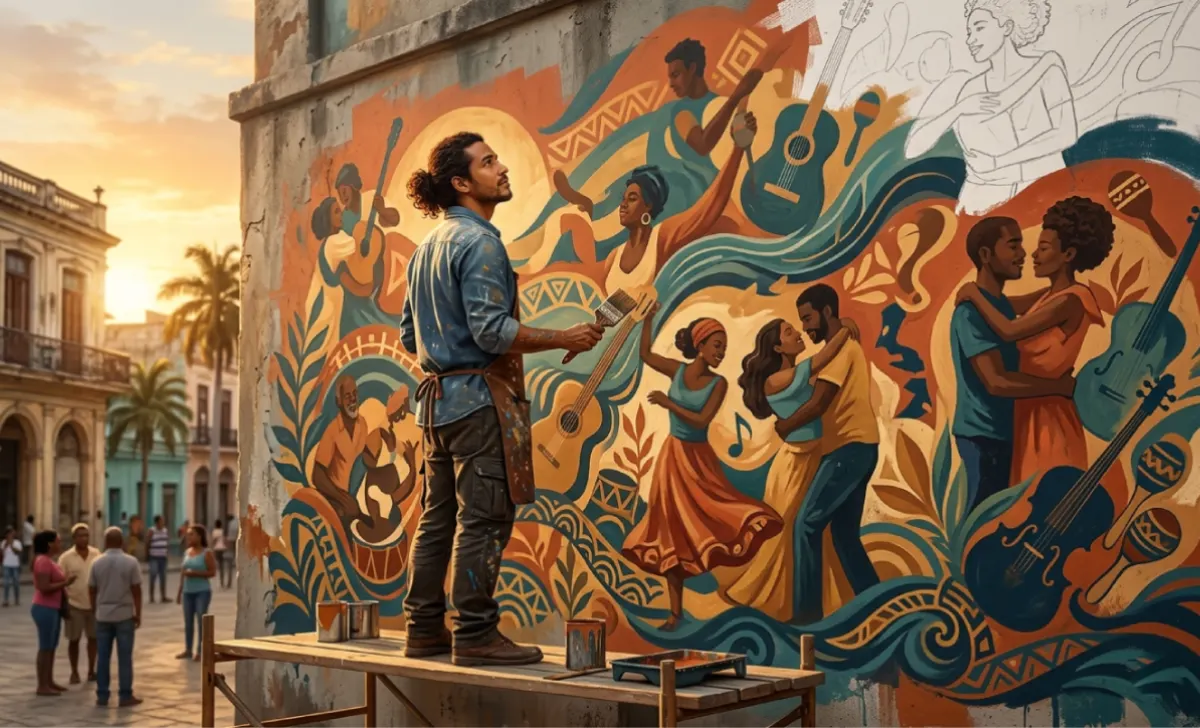
A practical example of this approach: When preparing a large community mural project, Socarras has been known to develop a corresponding musical piece at the same time — not to be performed at the unveiling, but to use as a reference point during the painting process. The music sets a tempo and emotional register that the visual work then responds to. The final mural carries that influence invisibly.
Themes: Cultural Celebration and Social Awareness Together
Royme Socarras does something technically difficult: he addresses serious social topics without losing the warmth or joy in his work.
His murals honour Latin cultural heritage — the music, the community, the visual traditions — while raising quieter questions about what it means to belong somewhere, or to be excluded from belonging. The same duality runs through his music, where rhythms carry both celebration and reflection simultaneously.
The social themes he returns to include:
- Inequality and economic exclusion — addressed not through protest aesthetics, but through the dignity with which he represents working-class and marginalised figures
- Environmental responsibility — woven into imagery without becoming didactic; natural elements carry symbolic weight without becoming lecture material
- Human rights and community belonging — explored through the relationship between figures in his murals, the spatial decisions in how people are grouped or isolated within a composition
What prevents these themes from becoming heavy-handed is technical. Socarras allows the viewer to arrive at meaning rather than directing them toward it. The messages are present and legible for someone who looks, but the work functions as experience first and argument second.
Marnie Fausch Banks has written thoughtfully about this challenge — the tension between an artist’s social commitments and the risk of reducing complex issues to simplified visual statements — and it offers useful context for understanding what Socarras is navigating in his own practice: see her piece here.
Artistic Technique: What Actually Makes It Work
Understanding what Socarras does technically helps explain why his work has the effect it does.
Scale as a communicative tool. His murals are large not simply because walls are large, but because scale changes the relationship between the viewer and the subject. A face painted at human scale feels different from the same face at three times that size. Socarras uses monumental scale deliberately — to make the subjects of his work impossible to walk past without acknowledging.
Material contrast. He regularly combines materials that have different visual textures — rough surfaces against smooth, matte against reflective, organic materials against manufactured ones. These contrasts create visual tension that keeps attention moving across a piece rather than settling at one focal point.
Colour grounded in cultural memory. The colour choices in his work are not arbitrary or purely aesthetic. They draw on the visual culture of his Cuban background — the specific warmth of Caribbean light, the particular combinations of colour that appear in architectural painting, textiles, and ceremony. This gives his palette a cultural specificity that is felt even by viewers who don’t consciously recognise the source.
Rhythm as structure. Both in his visual compositions and his music, rhythm functions as the primary structural principle. Shapes repeat and vary the way musical phrases repeat and vary. This gives his work a sense of internal logic — a feeling that the piece knows where it is going, even as it surprises you.
Impact: How His Work Reaches People
The influence Royme Socarras has on his audience is not the kind that makes headlines. It accumulates.
Viewers who spend real time with his murals tend to describe a gradual effect — an awareness that shifts slowly rather than a single dramatic moment of revelation. That quality of effect is much harder to produce than immediate visual impact, and it’s what distinguishes work built for lasting engagement from work built for immediate attention.
Within creative communities, he functions as a working example of how to stay connected to a personal cultural background while building an audience beyond it. For younger Latin-American artists in particular, that combination — specificity plus breadth — is something they’re watching and learning from.
His influence is also visible in the conversations his work generates outside gallery contexts. Community spaces where his murals appear report ongoing discussions prompted by the work long after the paint has dried. That kind of continued engagement — work that keeps producing conversation — is the mark of something more than decoration.
Alex Cowper-Smith has explored this question of lasting creative impact in ways that connect well with what Socarras is doing — the piece is worth reading alongside this one for a fuller picture of how contemporary artists think about legacy without letting it become performance.
How to Engage With His Work: A Practical Guide
If you’re encountering Socarras’s work for the first time, here are concrete ways to get more from the experience:
1. Start with the murals before the music. His visual work is the most immediately accessible entry point. Spend five minutes with one piece before moving on. Notice what draws your eye, and then notice what you keep returning to. Those two things are usually different, and the gap between them is where the work lives.
2. Let the music play through once without doing anything else. His tracks are structured to reward full attention. Background listening will give you texture. Active listening will give you the architecture underneath.
3. Read the context after you’ve had a first impression. Knowing the cultural or social background of a piece before seeing it can narrow your experience of it. Come to the work first, then find the context — it will deepen what you’ve already begun to feel rather than replacing it.
4. Look at his process documentation. Socarras has shared behind-the-scenes material from several projects. Watching how a piece develops — what gets added, what gets removed, what shifts in the middle of making — reveals the decision-making logic that the finished work contains but doesn’t explain.
5. Compare pieces across media. Find a track and a visual work made in the same period. Notice what they share. The parallels are rarely obvious, but they’re almost always there.
What Comes Next: Where His Practice Is Heading
Socarras is still actively developing as an artist, which means predicting a clear direction is less useful than identifying the consistent principles that have shaped his work so far.
Those principles appear to be:
- Staying close to lived experience rather than theorizing from a distance
- Refusing medium-specific specialisation in favour of genuine cross-disciplinary practice
- Treating cultural heritage as living material rather than a static reference
- Measuring success by audience effect rather than critical reception or market performance
Given these commitments, the most likely development is not a sharp stylistic shift but a deepening. As new tools and technologies become available — AI-assisted production, new materials for large-scale installation, expanded platforms for audio-visual combination — the question is whether those tools will serve the same underlying priorities or begin to pull the work in different directions.
The foundation, based on the body of work he has built, appears strong enough to absorb influence without losing shape.
Conclusion
There is no shortage of content in the current cultural landscape. What is genuinely scarce is work that costs the maker something real — time, attention, honesty, connection to what actually happened in a life.
Royme Socarras’s practice is notable not because it breaks stylistic ground in a way no one has attempted before, but because it consistently demonstrates what art looks like when the primary goal is human connection rather than audience capture. That distinction matters more now than it did a decade ago, when the competition for attention was less saturated, and the rewards for honest work were less diluted by volume.
Audiences are increasingly capable of recognising the difference between content made to be consumed and work made to be felt. Socarras sits clearly on the second side of that line.
If his work connects with you, the most useful response isn’t to research him further immediately. It’s to spend more time with one specific piece — and notice what it does to you while you’re sitting with it.
FAQs
What type of art does Royme Socarras make?
He works across multiple mediums, including large-scale murals, mixed-media painting, and music production. His practice deliberately connects these disciplines rather than treating them separately.
What cultural background informs Royme Socarras’s work?
His Cuban heritage is a central influence — visible in his use of colour, rhythm, and the cultural and social themes he returns to consistently. This background shapes not just the subject matter but the structural choices in his work.
What social themes appear in Royme Socarras’s art?
His work regularly engages with inequality, community belonging, environmental responsibility, and human rights. These themes are built into the work’s imagery and structure rather than stated directly.
How does he connect music and visual art in his practice?
He treats them as two sides of a single creative process. Musical compositions influence visual decisions — and vice versa — during the creation of each piece. The two media inform each other structurally and emotionally.
Where can I see Royme Socarras’s work?
His murals appear in community and gallery spaces, particularly in venues that feature cross-disciplinary or culturally grounded contemporary artists. Following galleries focused on Latin-American and multidisciplinary work is the most reliable way to track his exhibitions.
Is his work suitable for audiences with no art background?
Yes. His work is built to communicate at an experiential level before a conceptual one. You do not need prior art knowledge to engage with it — the emotional and sensory experience is available without that context.
What distinguishes his approach from other contemporary Latin-American artists?
The consistent integration of music and visual art within a single practice is relatively unusual. Most contemporary artists who draw on Latin cultural heritage do so primarily in one medium. Socarras’s cross-disciplinary approach creates a body of work with a distinctive internal coherence.