





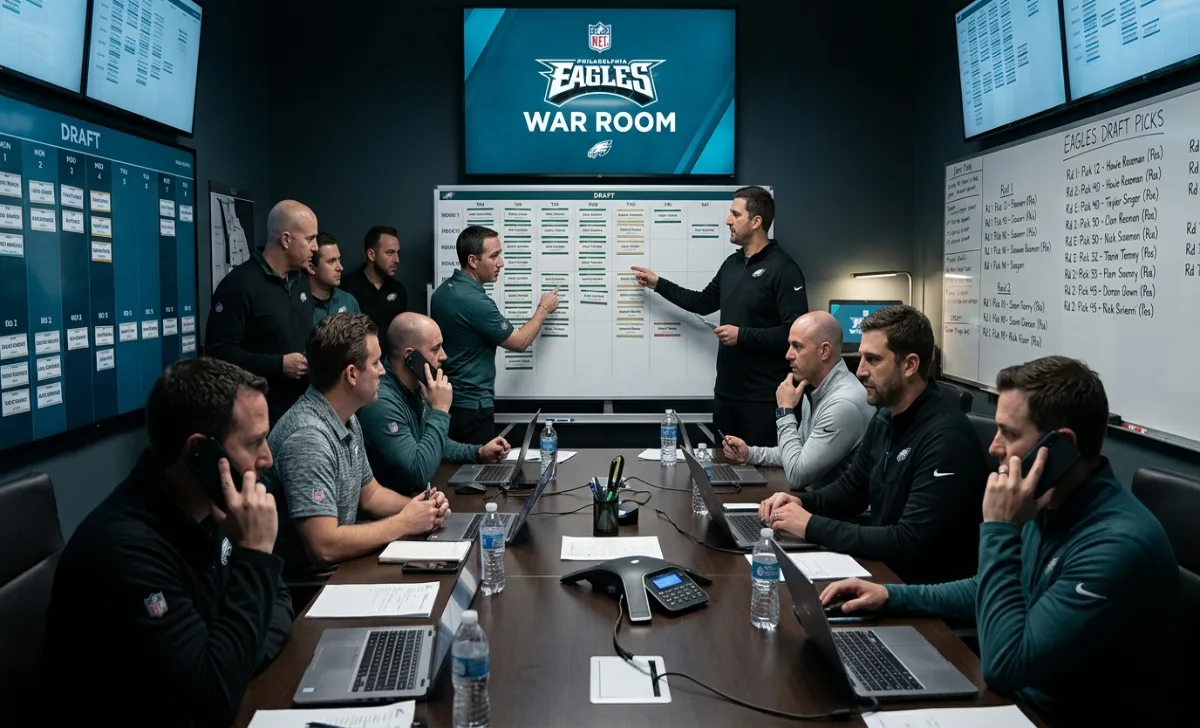
The Eagles explored trading a mid-round rookie shortly after the 2025 NFL Draft, during the post-draft to pre-minicamp window. Multiple teams reportedly called Philadelphia after the pick was announced. The Eagles engaged, discussed a package involving a 2026 fourth-round pick and a veteran contributor, then held onto the player when the right deal didn’t materialize.
The Eagles drafted their guy, then reportedly picked up the phone.
Shortly after the 2025 NFL Draft, Philadelphia’s front office fielded calls from multiple teams about one of their mid-round picks. Instead of shutting those conversations down, they engaged. At one point, they were reportedly close to moving that rookie for a 2026 fourth-round pick plus a veteran depth piece.
The deal didn’t close. But understanding why the Eagles even had that conversation tells you more about how this front office thinks than most of what gets written about them.
What Actually Happened With the Eagles’ Rookie Trade Attempt
The reported timeline runs from late April into early May 2025 — the window between the draft ending and pre-minicamp opening.
Several teams reached out to Philadelphia after the pick was announced. The Eagles listened. Based on reporting available at the time, the conversations got specific enough that a package was discussed: a 2026 fourth-rounder plus a known veteran contributor.
Important caveat: The team, the player’s name, and the exact package have not been confirmed by official team sources. The Eagles’ front office does not publicly comment on trade conversations that don’t close. What is confirmed is the general shape of what happened, and the Eagles’ pattern of operating this way is well-documented regardless.
Why the Eagles Considered It
Philadelphia already has solid depth at the position this rookie plays. In that situation, a mid-round rookie realistically gets 15 to 20 snaps a game in Year One — often less — while a team with a genuine hole at that spot will dramatically overpay to fill it.
That’s the leverage window. The Eagles identified it, tested it, and walked away when the return didn’t justify the move.
Howie Roseman has built his reputation on exactly this kind of cold-eyed asset management. He has traded future picks to move up when a player was worth it. He has moved veterans when the market was right. He treats the roster as a living document, not a finished product.
Post-draft trade exploration is a natural extension of that approach — not an anomaly.
How NFL Rookie Trade Rules Actually Work
Most fans assume there’s a waiting period before newly drafted players can be moved. There isn’t.
Rookies are tradeable the moment the draft ends. Practically speaking, the post-draft to pre-training camp window is when these conversations are most productive:
- Teams haven’t evaluated the new class in pads yet
- Roster needs are still fluid
- Picks feel more tradeable before a player has shown anything in preseason
- Desperate teams — ones that missed on a position earlier in the draft or lost someone to injury — are willing to overpay
Once training camp opens and players start showing what they can do, values shift quickly. Teams get attached. The Eagles’ conversations happened in exactly the right window for this kind of deal to make sense.
This Is More Common Than Fans Realize
Post-draft rookie trade exploration is standard operating procedure for contending teams. It is not a sign of dysfunction.
Contending franchises — teams with an open championship window right now — cannot afford to hold a mid-round pick for three years hoping he develops. They need to know whether that pick has more value as a player or as a chip. When another team is desperate, that chip is worth more than face value.
The Eagles are doing what smart teams do. They’re also doing what they’ve always done — staying active when others go quiet.
What About the Rookie?
The honest reality: finding out three weeks after draft day that your new team explored trading you is a strange thing to sit with.
Most veterans will tell you it goes one of two ways. Either it rattles you, or it sharpens you.
In this case, the Eagles kept him after fielding real offers. That’s nothing. They had an exit and chose not to take it. If he’s smart, he uses that as information — he knows exactly where he stands, without false promises.
What the Numbers Suggest About Mid-Round Rookies
Published NFL research and team analytics generally show that fewer than half of mid-round draft picks (rounds three through five) become consistent contributors within the first two years. The majority rotate through rosters or are released within three seasons.
Note: Specific figures vary by study, position group, and era. If you want precise data, Pro Football Reference and Next Gen Stats publish annual draft class tracking that is more reliable than general estimates.
The Eagles know this. They’re not pessimistic about this rookie — they’re managing probability the same way any organization manages uncertainty. A 2026 fourth-round pick plus a working veteran piece represents a real hedge against the odds that any given mid-round rookie doesn’t pan out.
How This Affects the Next Few Seasons
The trade didn’t close, but the willingness to explore it tells you how Philadelphia will operate going forward.
Two things to watch:
- They stay aggressive. Attachment to a draft pick will not stop this front office from improving the team if the right deal is available.
- They value future picks. A 2026 fourth-rounder keeps the draft pipeline active. It’s not a flashy move. It’s how rosters stay competitive across multiple seasons rather than peaking once.
Expect this approach to continue. The Eagles are not rebuilding. They are in win-now mode, and in win-now mode, every asset is constantly being evaluated.
What Eagles Fans Should Watch For
Snap counts, Weeks 1–4. If this rookie is playing 25 or more snaps a game early, the coaches are accelerating his development. That’s a good sign. If he’s barely seeing the field through October, don’t be surprised if trade talk resurfaces before the November deadline.
Roseman’s public language. He is careful with words. When he starts using phrases like “roster flexibility” or “keeping our options open,” that typically signals active conversations — not just philosophical openness.
Beat reporters with real sources. For Eagles trade news before it shows up everywhere else, Jeff McLane at The Philadelphia Inquirer and Reuben Frank at NBC Sports Philadelphia consistently break actual movement rather than speculation. Both have documented organizational access. Follow them, not rumor aggregators.
If another Eagles rookie trade attempt surfaces later in the year, don’t overreact. That’s just how this front office operates.
Final Thought
The Eagles’ rookie trade attempt was not dysfunctional. It was not disrespect toward the player.
It was a front office doing its job: evaluating every asset clearly, staying open to value, and refusing to let emotional attachment drive decisions that should be driven by math.
They listened. They explored. The right deal wasn’t there, so they held on. That’s not indecision — that’s how you stay a contender year after year instead of burning out after one run.
The 2026 season will be worth watching. This front office gives you reasons to pay attention.
FAQs
Did the Eagles actually try to trade a rookie, or is this speculation? Based on the reporting available at the time, the conversations were real. The Eagles fielded calls from multiple teams and explored a specific return package. The deal did not close, and official team sources have not confirmed details — which is standard; teams don’t publicly discuss trades that don’t happen.
Why would a team trade a rookie right after drafting them? Roster fit and asset math. If you already have depth at that position and another team is desperate, you can convert one developing player into multiple assets — often a future pick plus an immediate contributor. The post-draft window is the right time to test that market.
Does a trade attempt mean the Eagles don’t like the player? No. Keeping him after fielding real offers is itself a signal. The Eagles were looking to see if the return justified the move. When it didn’t fully materialize, they held on. That’s a choice, not a default.
Could the Eagles try to trade him again before the season starts? Possible, but less likely as Week 1 approaches. The closer teams get to the regular season, the more familiar faces matter. Trade value for a rookie who hasn’t played drops yet as preseason data becomes available.
Should Eagles fans be concerned about how the front office treats players? No. This is standard roster management at the contender level. The Eagles have shown they can develop young players and make sharp trades simultaneously. Those two things are not in conflict.